

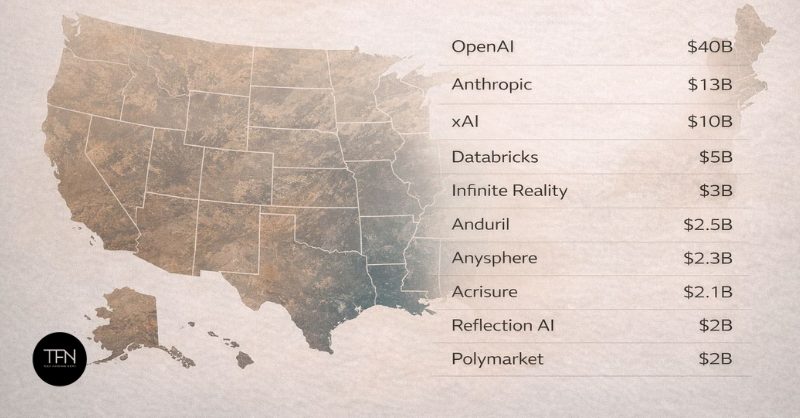
Dailyza analysis: the biggest U.S. fundraising rounds of 2025 paint a market defined less by a single “hot sector” and more by a widening barbell. On one end sit enormous, balance-sheet-scale raises that resemble quasi-public financing. On the other are “smaller” multi-billion-dollar rounds—still massive by historical standards—aimed at extending runway, consolidating categories, and funding infrastructure that can survive tighter underwriting.
The headline range—roughly $40 billion at the top down to around $2 billion at the bottom of the top-10 list—matters because it signals how investors are pricing risk in 2025. Capital is flowing most freely to companies that can credibly claim one or more of the following: durable demand, strategic relevance to national or industrial priorities, and a path to cash generation that does not depend on perpetual cheap money.
A barbell market: massive checks and selective conviction
In prior boom cycles, large rounds often clustered around the same themes—consumer growth, rapid expansion, and “land grab” narratives. In 2025, the spread between the very largest rounds and the rest suggests a different dynamic: a small number of companies are attracting extraordinary sums because they sit at the intersection of scale, strategic necessity, and scarcity.
At the same time, the lower end of the top-10 spectrum—still in the multi-billion-dollar range—reflects a market where investors are willing to write big checks, but only when milestones are explicit. This is the era of capital efficiency as a term sheet requirement, not a slogan.
Why the top of the list looks “public” even when it isn’t
Rounds at the extreme high end increasingly function like pre-IPO recapitalizations or structured financings. They can include secondary liquidity, complex preference stacks, and investor protections that mirror public-market expectations. The message is clear: if a company wants a check measured in tens of billions, it must behave like a public company—on reporting discipline, governance, and risk controls—even if it remains private.
Where capital is concentrating in 2025
Across the top U.S. rounds, several themes repeatedly appear, not always as pure-play categories but as underlying drivers of investor conviction.
- AI infrastructure and compute-adjacent businesses that can justify long-term demand and pricing power.
- Energy transition and grid resilience, especially where projects align with industrial policy and long-lived assets.
- Defense and dual-use technologies, as procurement tailwinds and geopolitical realities expand the buyer base.
- Healthcare platforms with measurable outcomes, reimbursement clarity, and enterprise-grade compliance.
- Mature fintech and payments players raising to scale distribution, manage risk, or pursue consolidation rather than subsidized growth.
Notably, the winners are often those that can translate narrative into contracts. Investors in 2025 are asking: Who is already paid for this? Who can keep getting paid for this? And who can defend margins when competitors also raise?
The $40B-to-$2B spread: what it reveals about pricing and power
The sheer distance between the largest and smallest rounds in the top-10 set points to an important reality: access to capital is not evenly distributed, even among market leaders. In 2025, fundraising has become a competitive advantage in itself, enabling the best-capitalized firms to lock up supply chains, secure long-term compute capacity, hire scarce technical talent, and outlast slower-moving rivals.
Scale is back—but with conditions
Investors are not rejecting scale; they are underwriting it differently. Mega-rounds are going to companies that can demonstrate operational maturity and credible unit economics, or to those with strategic assets that are difficult to replicate. That includes proprietary data, regulated distribution, specialized manufacturing, or infrastructure that becomes more valuable as others build on top of it.
In practical terms, that means fewer “growth at any cost” financings and more deals that look like a bet on enduring cash flows—whether those cash flows arrive through enterprise contracts, government spend, or long-term offtake agreements.
What founders should learn from 2025’s top rounds
For founders watching the largest U.S. rounds and hoping to replicate them, the lesson is not simply to chase the biggest check. The more useful takeaway is to understand what the market is rewarding.
- Proof of demand beats projections: signed contracts, renewals, and clear pricing power are driving valuations.
- Risk management is a product feature: security, compliance, and reliability are now fundraising fundamentals.
- Strategic positioning matters: alignment with national priorities, supply-chain resilience, or regulated markets can expand the investor pool.
- Runway is leverage: companies that can choose timing—rather than being forced to raise—negotiate better terms.
Even at the “low” end of the top-10 list, multi-billion-dollar rounds are not being handed out for momentum alone. They are being priced around execution risk, margin durability, and the ability to reach a liquidity event without repeated dilution.
What this means for the rest of the market
The top-10 rounds are not just headlines; they influence how capital allocators behave downstream. When the largest deals cluster around infrastructure, defense, energy, and enterprise-grade AI algorithms, it can pull talent and follow-on dollars away from more speculative consumer categories. It can also raise the bar for everyone else: if leaders can raise billions, late-stage peers may be expected to show comparable discipline, even without comparable scale.
For limited partners and fund managers, the spread reinforces a core 2025 reality: returns may hinge on fewer, larger winners, while the middle of the market faces more scrutiny. For operators, it underscores that fundraising is increasingly tied to strategic relevance and measurable performance, not just story.
The $40B-to-$2B spectrum is ultimately a snapshot of power in the modern private market: capital is abundant for the companies building essential infrastructure and scarce for those selling optionality. That is where the money is going in 2025—and where it is likely to keep going as long as investors remain disciplined about durability over hype.