

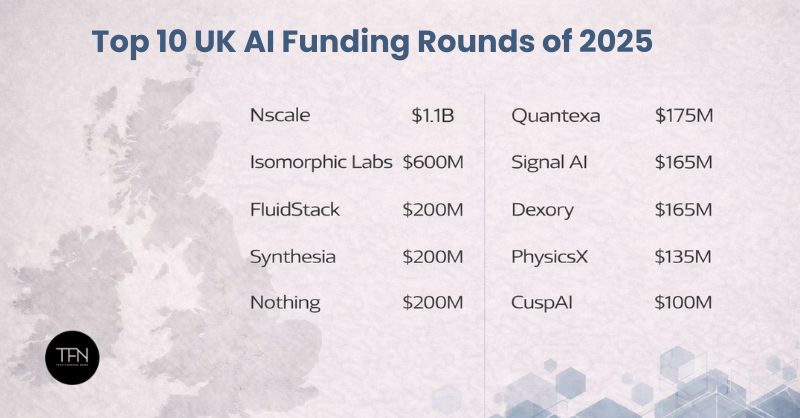
Dailyza analysis: UK-based AI companies collectively pulled in more than £2 billion in disclosed funding in 2025, underscoring how investor appetite has shifted from broad “AI everywhere” enthusiasm toward fewer, larger bets on infrastructure, enterprise deployment, and regulated-industry use cases.
The year’s biggest rounds also highlight a defining tension for the UK market: capital is available for teams that can demonstrate distribution, compute access, and defensible data, but the bar for “venture-scale” differentiation has risen sharply. Investors are rewarding companies that turn model capability into measurable business outcomes—cost reduction, security, compliance, and productivity—rather than novelty alone.
Why 2025 became a megadeal year for UK AI
After a period of cautious funding across global venture markets, 2025 saw a re-acceleration in larger UK AI rounds as firms sought exposure to businesses positioned to benefit from enterprise adoption and government interest in domestic capability. The UK’s advantage remains its density of research talent, strong startup formation, and a mature financial-services customer base that can adopt AI quickly—provided governance and risk controls are in place.
At the same time, the “compute question” has become central. Startups building or fine-tuning models at scale face rising costs and strategic dependency on cloud providers and GPU supply. This has pushed more funding toward companies that either (a) build tools that reduce inference and training costs, (b) provide infrastructure and orchestration layers, or (c) own proprietary datasets in high-value verticals.
What the biggest UK AI deals typically funded
Across the largest 2025 UK rounds, several patterns emerged in how proceeds were expected to be used:
- Compute and model operations: budget for training, fine-tuning, evaluation, and deployment pipelines, plus long-term cloud commitments.
- Enterprise go-to-market: expanding sales teams, customer success, and integration partnerships to shorten procurement cycles.
- Safety, governance, and compliance: meeting requirements in sectors like finance, healthcare, and public services, including auditability and data controls.
- International expansion: particularly into the US and EU, where large enterprise contracts can rapidly scale revenue.
Importantly, investors appear to be pricing in the reality that many AI companies will need sustained capital to compete—either because infrastructure costs are persistent or because enterprise adoption requires long implementation timelines.
Which themes dominated investor interest
1) AI infrastructure and tooling
Funding momentum has increasingly favored the “picks and shovels” layer: developer platforms, observability, evaluation frameworks, and orchestration tools that help companies deploy models responsibly and cost-effectively. As more businesses move from pilots to production, the market for tooling that proves reliability, reduces hallucinations, and manages data lineage has expanded.
These companies can also benefit from diversified customer bases. Rather than betting on a single end-market, they can sell across fintech, retail, telecoms, and government—an attractive profile during periods of macro uncertainty.
2) Regulated-industry applications
UK strengths in financial services and healthcare continue to shape venture priorities. Investors have shown growing preference for AI products that embed compliance and risk controls by design, especially where procurement requires demonstrable safeguards. In these categories, founders are expected to speak fluently about model governance, audit trails, and data minimisation—not just accuracy benchmarks.
3) Cybersecurity and defence-adjacent capabilities
As AI expands the attack surface—through automated phishing, deepfakes, and faster vulnerability discovery—security-focused AI has become a major funding magnet. Buyers increasingly want systems that can detect anomalies, automate response, and reduce analyst workload without creating opaque “black box” decisions.
4) Enterprise productivity with provable ROI
The market has matured beyond generic copilots. The strongest enterprise productivity plays are those integrated into existing workflows and tied to measurable outcomes: reduced handling time in customer support, faster contract review, improved compliance reporting, or lower operational costs. In 2025, “show me the savings” has become a common refrain in procurement, and venture investors are following that discipline.
What £2B+ in funding means for the UK’s AI position
Crossing the £2 billion mark in disclosed UK AI fundraising is more than a headline number. It signals that the UK remains investable at scale, even as competition intensifies from the US, France, and other European hubs. Large rounds can create flywheels—enabling talent acquisition, faster product cycles, and the credibility needed to win enterprise contracts.
But the same megadeals also raise the stakes. Bigger rounds come with higher expectations for revenue growth, international expansion, and defensible moats. For many teams, that will require more than model performance; it will require distribution, data access, and partnerships that lock in customers over multi-year deployments.
Risks investors are watching closely
Despite the upbeat funding totals, 2025’s dealmaking has not erased structural risks. Venture firms and corporate buyers are scrutinising:
- Unit economics as inference costs fluctuate and pricing pressure increases.
- Vendor concentration in cloud and GPU supply chains.
- Regulatory exposure as AI governance frameworks evolve across the UK and EU.
- Competitive durability when open-source models and Big Tech offerings improve quickly.
These concerns help explain why capital is clustering in companies with clear differentiation—unique data, proprietary distribution, or mission-critical integration—rather than spreading evenly across the ecosystem.
What to watch in 2026
If 2025 was the year UK AI fundraising consolidated into larger rounds, 2026 is likely to test whether those megadeals translate into durable businesses. Expect more emphasis on revenue quality, multi-year contracts, and evidence that AI deployments are sticking beyond pilots. Investors will also watch whether the UK can strengthen domestic compute capacity and keep top talent from migrating to better-funded markets.
For now, the £2B+ milestone shows that UK AI remains a central arena for venture capital—one where the next wave of winners will be defined as much by execution and trust as by technical ambition.