

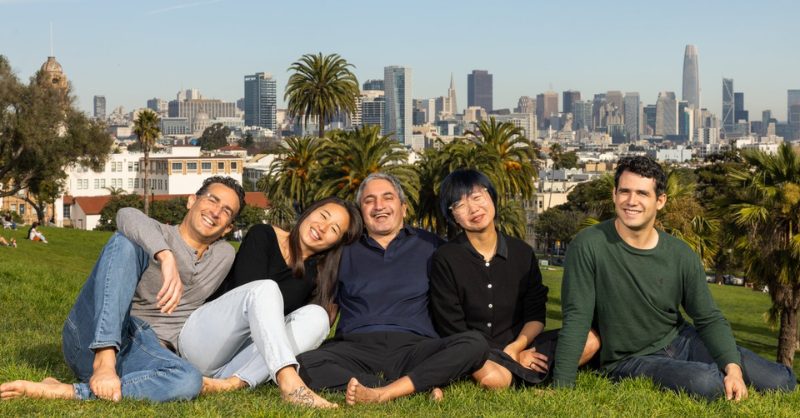
Humans& emerges with $480M to redefine AI research
A new AI powerhouse is taking shape as a group of former OpenAI researchers have quietly launched Humans&, securing an eye‑catching $480 million funding round. The scale of the raise instantly places the company among the best‑capitalised independent AI labs and has sparked a central question in the industry: can this new entrant out‑innovate established research outfits such as Thinking Machines Lab?
Backed by a mix of top‑tier venture capital firms and strategic investors, Humans& is positioning itself as a research‑driven organisation focused on building powerful but controllable AI systems that work in close partnership with humans rather than replacing them outright.
A human‑centric spin‑out from OpenAI
While full details of the founding team remain under wraps, industry sources point to a core group of senior scientists and engineers who previously worked on large‑scale foundation models and alignment research at OpenAI. Their departure underlines a growing trend: top AI talent is increasingly leaving major labs to build more focused, independent research companies.
The brand name Humans& is deliberate. It signals a belief that the next wave of artificial intelligence will be defined not just by raw model capability, but by the quality of collaboration between humans and machines. Rather than chasing headline‑grabbing benchmarks alone, the new lab is said to be concentrating on:
- Developing assistive AI agents that can work alongside knowledge workers.
- Advancing AI safety and alignment techniques to keep systems reliable under real‑world conditions.
- Designing new human‑computer interaction paradigms that make advanced models more transparent and controllable.
The scale and strategy behind the $480M round
The reported $480 million raise puts Humans& in the same funding league as the most ambitious independent labs founded in the last five years. For investors, the logic is straightforward: training frontier‑level large language models and multimodal systems now requires enormous capital for GPU clusters, data infrastructure and elite research teams.
According to people familiar with the round, the capital will be deployed across three main buckets:
- Compute infrastructure: Securing long‑term access to cutting‑edge AI accelerators and cloud resources to train models at scale.
- Research and talent: Recruiting leading experts in machine learning, reinforcement learning, AI safety and distributed systems.
- Productisation: Turning research breakthroughs into deployable AI platforms and tools that enterprises can integrate into existing workflows.
Investors are betting that a lean, research‑first organisation can move faster than larger incumbents that are increasingly constrained by product roadmaps, regulatory scrutiny and legacy infrastructure.
Can Humans& outpace Thinking Machines Lab?
The arrival of Humans& inevitably draws comparisons with Thinking Machines Lab, another research‑focused organisation that has gained attention for its work on advanced AI architectures and computational reasoning. Both groups share a commitment to fundamental research, but they appear to be taking distinct strategic paths.
Different bets on the future of AI
Thinking Machines Lab has built its reputation on exploring novel model architectures and specialised AI hardware optimisations. Its work is often cited in academic circles and has influenced how other labs design scalable training pipelines.
Humans&, by contrast, is positioning itself closer to the intersection of AI research, product design and ethics. Instead of focusing solely on model performance, it is expected to invest heavily in:
- Human‑in‑the‑loop training methods that use expert feedback to guide model behaviour.
- Robust evaluation frameworks that measure not just accuracy but also reliability, bias and interpretability.
- Practical AI governance tools for enterprises and public institutions.
That divergence may prove decisive. If the market rewards safe, controllable and regulation‑ready systems, Humans& could find itself with a meaningful edge over more academically oriented rivals.
Competition for talent, compute and customers
Where the two labs will compete most directly is on three scarce resources: talent, compute and customers.
- Talent: The same pool of senior AI researchers and engineers is being courted by both organisations. The ex‑OpenAI pedigree of Humans& may give it an early recruiting advantage.
- Compute: Access to state‑of‑the‑art GPU and TPU capacity is now a strategic chokepoint. The size of the $480M round suggests Humans& intends to secure multi‑year compute commitments.
- Customers: As enterprises race to adopt AI copilots and automation, both labs are likely to court large corporate and government partners seeking differentiated capabilities.
Whether Humans& can “beat” Thinking Machines Lab will depend less on research papers published and more on who can convert breakthroughs into reliable, trusted systems that organisations are willing to deploy at scale.
What this means for the AI ecosystem
The emergence of Humans& is another signal that the AI landscape is fragmenting into a network of well‑funded, specialised labs rather than a small set of dominant giants. For the broader ecosystem, several implications stand out:
- Faster innovation cycles: Independent labs can iterate quickly on new model architectures, training methods and alignment techniques.
- More diversity of approaches: A wider range of research agendas reduces the risk of the industry converging prematurely on a single paradigm.
- Regulatory pressure: As capital flows into powerful new labs, regulators are likely to intensify scrutiny around AI safety, data governance and competition policy.
For enterprises and developers, the rise of Humans& could translate into more choice. Instead of relying solely on a handful of cloud providers, they may gain access to specialised AI platforms tailored for sectors such as finance, healthcare, manufacturing or the public sector.
Dailyza’s view: a race defined by trust, not just scale
From a strategic standpoint, the defining contest between Humans& and rivals like Thinking Machines Lab will not be measured only in model size or benchmark scores. The decisive factor is likely to be trust: which lab can convince regulators, enterprises and end‑users that its AI systems are safe, aligned and economically valuable.
With $480M in fresh capital and a founding team drawn from the heart of OpenAI, Humans& has bought itself a long runway to pursue that vision. Whether it ultimately reshapes the balance of power in advanced AI will depend on execution over the next several years—and on how effectively it can turn a human‑centric philosophy into products that matter in the real world.