

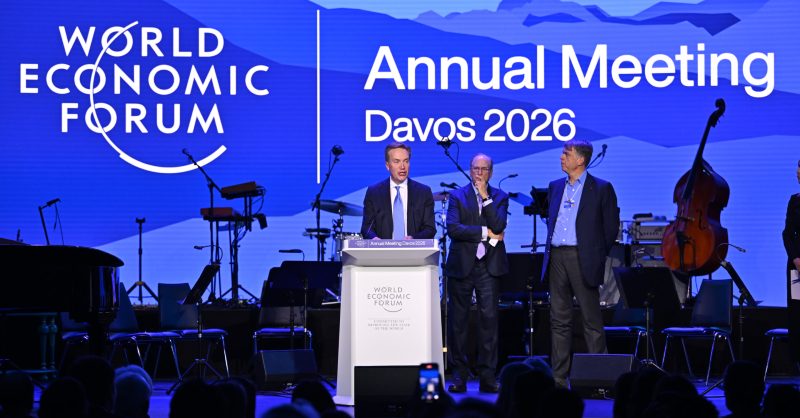
Europe’s AI wake‑up call at Davos 2026
At the 2026 World Economic Forum in Davos, Europe’s struggle to keep pace in the global artificial intelligence race moved from corridor whispers to centre stage. Politicians, investors and founders converged around a single hard truth: while European research in AI and deeptech remains world class, capital and commercial power are still tilting sharply toward the United States and China.
Panels and closed‑door sessions repeatedly returned to the same question: can Europe move fast enough on funding, regulation and industrial strategy to avoid becoming a junior partner in the next wave of technological transformation?
Capital swings toward deeptech – but not evenly
Global investors at Davos highlighted a structural shift in venture flows. After years of pouring money into consumer apps and fintech, institutional capital is now rotating toward deeptech – including foundation models, semiconductors, robotics, and climate tech. Yet the bulk of the largest rounds are still being closed in Silicon Valley and key Chinese hubs.
European founders described a familiar pattern: breakthrough research is often born in European universities and labs, only for scale‑up capital and commercial leadership to migrate abroad.
Several investors argued that the problem is not the absence of money in Europe, but the structure of it. Pension funds and insurers remain cautious about high‑risk, long‑cycle AI bets, while fragmented national markets dilute the impact of successful funding schemes.
Policy makers promise a new phase of AI industrial strategy
European officials used the Davos stage to signal a more assertive stance. Delegations from major EU economies framed AI as critical infrastructure, on par with energy and transport, and hinted at expanded public‑private investment vehicles designed specifically for deeptech.
From regulation first to regulation and scale
Europe’s pioneering AI regulation has been widely praised for its emphasis on safety, transparency and fundamental rights. Yet several speakers acknowledged that a “regulation‑first” narrative, without a matching scale‑up agenda, has reinforced perceptions that Europe is a difficult place to build world‑leading AI companies.
At Davos, officials stressed a shift in tone: guardrails will remain, but they will be paired with targeted incentives for compute infrastructure, talent retention and cross‑border data collaboration. New pan‑European programmes are being designed to help startups access high‑performance computing and shared AI training datasets without forcing them to relocate.
Startups push for bolder, faster European action
Founders from across the continent used Davos to press for concrete changes. Their message was consistent: Europe cannot win the AI race with small pilots and fragmented grants.
The scale‑up bottleneck
Entrepreneurs noted that early‑stage funding for AI startups has improved, with strong angel and seed ecosystems in hubs such as London, Paris, Berlin and the Nordics. The real gap emerges at Series B and beyond, when capital requirements for AI models, data infrastructure and global go‑to‑market strategies climb sharply.
Several founders argued that without sovereign‑level commitments to AI compute and long‑term R&D, Europe risks becoming a customer rather than a creator of the most powerful AI systems. They called for streamlined access to public contracts, faster approval for cross‑border projects and simplified rules for stock‑based compensation to compete for top talent.
The global context: US and China widen their lead
Outside the European bubble, Davos conversations underscored how far the global frontier has moved. US‑based giants continue to dominate investment in foundation models, AI chips and large‑scale cloud infrastructure, while Chinese firms push ahead in industrial automation, smart cities and AI‑driven manufacturing.
Analysts warned that if Europe does not move quickly, key layers of the AI value chain – from advanced semiconductors to large‑scale training platforms – could be effectively locked up by non‑European providers. That would leave European companies dependent on foreign technology stacks for everything from healthcare diagnostics to automotive autonomy.
From research power to AI products: Europe’s opportunity
Despite the warnings, Davos 2026 also highlighted Europe’s structural advantages. The continent still produces a disproportionate share of the world’s top AI researchers, and its strengths in industrial engineering, automotive, robotics and climate science align closely with the next wave of applied AI.
Deeptech aligned with real‑world problems
Investors pointed to European leadership in areas such as AI‑enabled manufacturing, energy optimisation, medical imaging and drug discovery. These domains require long‑term, technically sophisticated bets – exactly the kind of projects now attracting global attention as generic consumer apps hit saturation.
If Europe can channel more late‑stage capital into these strengths, and ensure that regulatory frameworks reward responsible innovation rather than merely punishing misuse, the continent could carve out a defensible position in mission‑critical deeptech.
What changes next after Davos 2026?
While Davos is often criticised for talk over action, this year’s focus on AI left several tangible expectations on the table for Europe:
- Expansion of pan‑European funds dedicated to deeptech and AI infrastructure.
- New incentives for institutional investors to back long‑horizon AI ventures.
- Greater coordination on compute capacity so startups can train advanced models without leaving Europe.
- Pragmatic implementation of AI regulation that supports experimentation while enforcing safety.
For European leaders, the message from Davos 2026 was clear: the world will not slow down its AI progress while Europe debates. The next two to three years will determine whether the continent can translate its scientific excellence and ethical ambitions into globally competitive AI platforms and companies – or watch the centre of gravity move even further away.
As global capital continues to swing decisively toward deeptech, Davos has become less a networking ritual and more a scoreboard. In 2026, that scoreboard shows Europe behind, but not yet out of the game.