

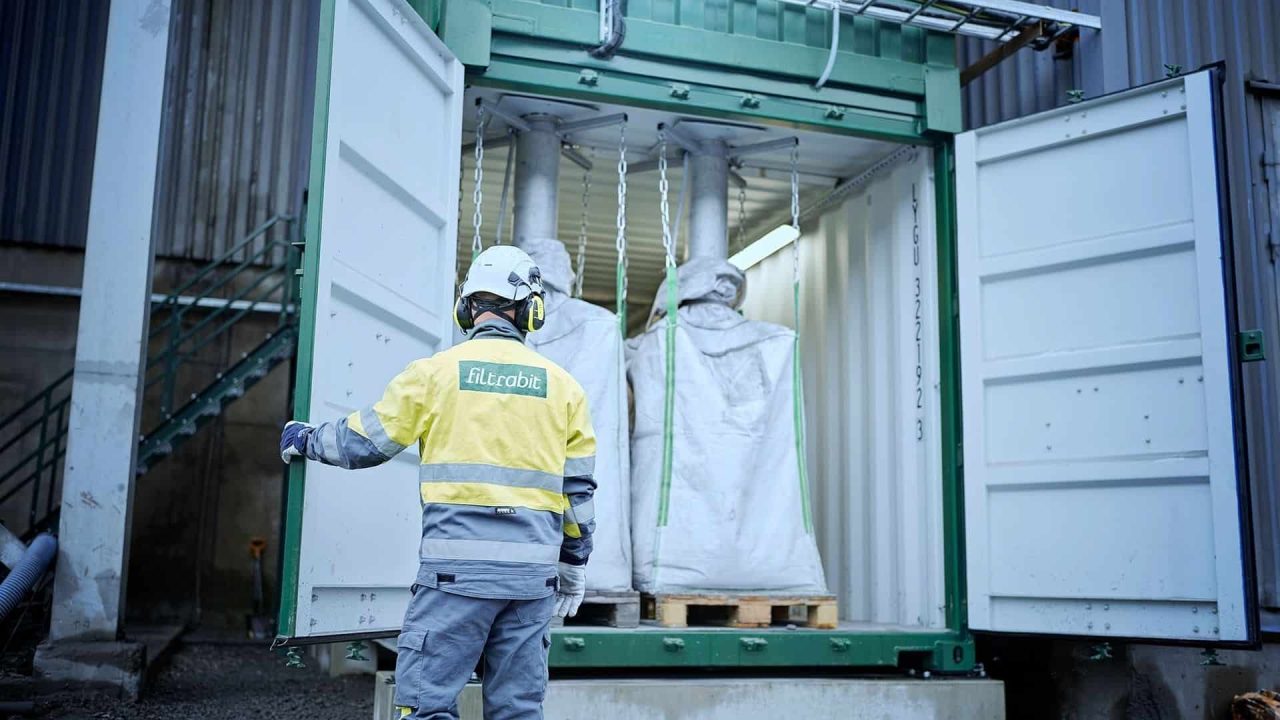
Finland’s Filtrabit has secured a €2 million funding commitment to accelerate its work on reducing particulate pollution from heavy industry, a persistent public-health and regulatory challenge across Europe. The financing is set to support deployment and product development aimed at industrial sites where dust and fine particles are generated during high-temperature and high-throughput processes.
The commitment, first reported by EU-Startups, arrives as manufacturers face mounting pressure to curb air emissions while maintaining output. For Filtrabit, the round is a vote of confidence that industrial air-cleaning technologies—once treated as compliance costs—are increasingly seen as core operational investments tied to worker safety, community relations, and long-term competitiveness.
Why particulate pollution is an urgent industrial problem
Particulate matter—including fine particles often referenced as PM10 and PM2.5—can be produced in industrial settings such as metal processing, mining-related operations, cement and aggregate handling, and other heavy manufacturing environments. These particles can travel beyond factory boundaries, affecting nearby neighborhoods, and can also concentrate inside facilities, impacting employees and equipment.
Beyond health concerns, particulate build-up can create operational issues: abrasion, corrosion, reduced equipment efficiency, and higher maintenance cycles. For many operators, the challenge is not only capturing particles, but doing so consistently under variable loads, temperatures, and process conditions—without disrupting production.
What Filtrabit says it is building
Filtrabit is positioning its solution around industrial-scale filtration aimed at capturing particulate emissions at or near the source. While the company’s public details in the provided input are limited, the stated mission—tackling particulate pollution in heavy industry—signals a focus on the types of emissions that are hardest to manage with generic, off-the-shelf systems.
In practice, heavy-industry filtration typically demands more than a single component. Effective systems often combine capture hoods or enclosures, ducting designed for high-dust flows, filtration units sized for peak loads, and monitoring that can detect performance drift. Startups in this category frequently differentiate through improved filter media, smarter system controls, better energy efficiency, or modular retrofits that reduce downtime during installation.
How the €2 million commitment could be used
A €2 million funding commitment can be meaningful in industrial climate and clean-air technologies, particularly for a company moving from pilots to repeatable deployments. For Filtrabit, the capital is likely to support a blend of engineering, commercial scaling, and on-site implementations—each of which is costly in heavy industry due to long sales cycles and strict safety requirements.
Typical near-term priorities for industrial clean-air scale-ups
- Productization: turning bespoke pilot setups into standardized modules that can be installed faster and serviced more easily.
- Field validation: collecting performance data across different industrial environments to prove capture rates and reliability.
- Manufacturing readiness: securing suppliers and building the capacity to deliver systems on predictable timelines.
- Go-to-market expansion: hiring for sales, project delivery, and compliance support to navigate permitting and site acceptance tests.
Industrial buyers typically require clear evidence that filtration systems will perform under real operating conditions, not just controlled test runs. That often means extended trials, third-party measurements, and documentation aligned with environmental and occupational standards.
Regulatory and market tailwinds in Europe
Across the EU, the direction of travel is toward tighter air-quality expectations and more rigorous reporting. Even when rules vary by country, large industrial operators increasingly face scrutiny from multiple stakeholders: regulators, local communities, insurers, and supply-chain partners that have their own sustainability requirements.
This creates a market opening for companies that can help plants reduce emissions without sacrificing productivity. In sectors where margins can be thin and downtime is expensive, solutions that are easier to retrofit, more energy-efficient, or more predictable to maintain can gain traction faster than complex overhauls.
Why investors are paying attention to particulate control
Funding for industrial decarbonization often dominates headlines, but particulate control is gaining renewed interest because it addresses an immediate and measurable outcome: fewer airborne particles. Unlike multi-decade transitions, filtration upgrades can sometimes be implemented within months, offering a clearer pathway from investment to impact.
From an investor perspective, industrial clean-air technology can also align with several attractive characteristics:
- Large addressable markets tied to essential industries.
- Strong compliance-driven demand that can persist through economic cycles.
- Potential for recurring revenue through service contracts, consumables, and monitoring.
- Opportunities to expand from one facility to multi-site rollouts once performance is proven.
What to watch next for Filtrabit
The key questions following the funding commitment will likely center on execution: where Filtrabit deploys next, how quickly it can convert industrial interest into contracts, and whether it can demonstrate reliable performance at scale. In heavy industry, credibility is often earned through long-run operational data, maintenance records, and endorsements from early customers.
If Filtrabit can show that its approach reduces particulate emissions consistently—while keeping energy use and maintenance demands manageable—it could become a valuable partner for industrial operators navigating stricter air-quality expectations. The company’s next milestones will likely be measured not only in euros raised, but in verified reductions in dust and fine particles at operating plants.