

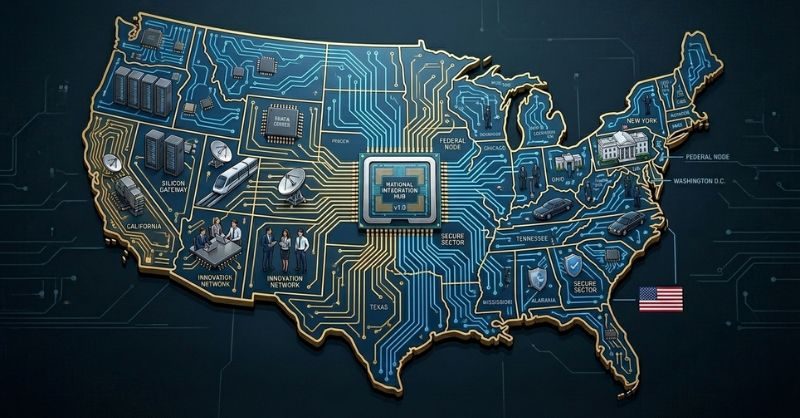
US science council quietly rewrites the industrial rulebook
A little‑noticed report from a top US advisory body on science and technology is shedding light on how Washington is rebuilding an explicit industrial strategy after decades of market-first orthodoxy. The council’s analysis, circulated among senior policymakers, details how the US is using targeted public investment, export controls and alliances to secure leadership in semiconductors, clean energy and other strategic technologies.
From laissez‑faire to targeted state support
For much of the post‑Cold War era, US economic policy was framed around deregulation and global supply chains. The council’s report signals a decisive shift. Drawing on lessons from the pandemic and geopolitical tensions, it argues that the US can no longer rely solely on private markets to safeguard access to critical inputs such as advanced chips, rare earths and battery materials.
Instead, the document outlines a coordinated playbook: large‑scale subsidies for domestic production, tighter screening of foreign investment, and strategic stockpiles for key materials. These tools, once associated with traditional industrial policy, are now being justified on the grounds of national security and long‑term innovation capacity.
Semiconductors and clean tech at the core
The council identifies advanced semiconductor manufacturing as the central battleground. New fabrication plants supported by federal incentives are intended to anchor entire ecosystems of suppliers, researchers and skilled workers inside US borders. Similar approaches are proposed for electric vehicle batteries, grid‑scale storage and next‑generation renewable energy technologies.
Crucially, the report stresses that public money must be tied to measurable outcomes: domestic capacity, resilient supply chains and technology transfer from labs to factories. It calls for closer coordination between agencies funding R&D and those overseeing trade, defense and energy policy.
Allies, standards and the geopolitics of innovation
The industrial playbook extends beyond US borders. The council urges deeper cooperation with trusted allies on joint research, shared manufacturing capacity and common technology standards. At the same time, it endorses tighter export controls on the most sensitive AI chips and advanced manufacturing tools, particularly where they could enhance rival military capabilities.
By making these choices explicit, the science and technology council is effectively codifying a new era of US statecraft: one where industrial policy, science and geopolitics are inseparable, and where control over critical technologies is treated as a foundation of national power.