

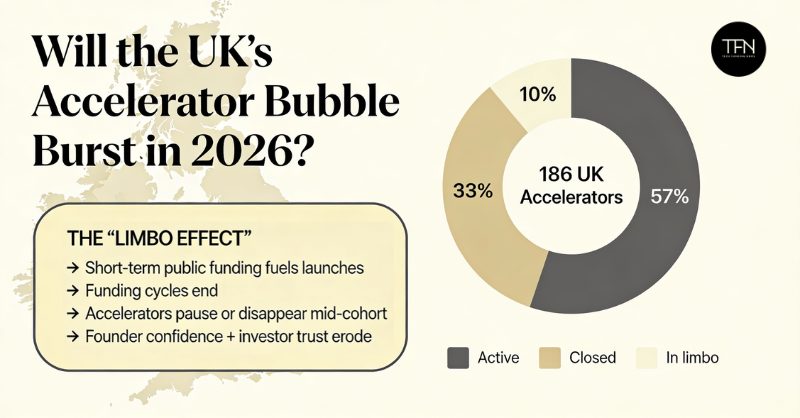
The UK has built one of Europe’s densest networks of startup accelerators—186 programmes in total—yet a striking share of that ecosystem is no longer fully operational. New analysis suggests around 43% of UK accelerators are either closed or “in limbo,” raising a pointed question for founders and investors: is the UK experiencing an accelerator bubble finally deflating, or a market that is maturing and shedding weaker models?
The figures point to a country that has historically excelled at creating early-stage support structures, but is now confronting the harder part: sustainability. As capital becomes more selective and startup timelines lengthen, many accelerators are being forced to prove they can consistently produce fundable companies, talent pipelines, and measurable economic outcomes.
Why the UK built so many accelerators in the first place
Accelerators expanded rapidly across the UK over the past decade, helped by London’s global investor base and strong university research networks in cities such as Oxford, Cambridge, Edinburgh, Manchester, and Bristol. For policymakers, accelerators offered a relatively fast way to support entrepreneurship compared with longer-horizon infrastructure projects. For corporates, they were a structured channel to engage with innovation without committing to full acquisitions.
At their best, accelerators provide founders with mentorship, customer introductions, legal and fundraising support, and early capital—often in exchange for equity. The model can compress learning cycles and help teams avoid expensive mistakes at a stage when runway is limited.
What “closed or in limbo” really means
The headline statistic—43% closed or in limbo—captures a range of realities. Some programmes have shut down entirely after failing to secure follow-on funding or corporate sponsorship. Others still exist on paper but have paused cohorts, reduced staff, or shifted to “community” formats without a defined investment thesis.
For founders, that ambiguity matters. A programme that is technically active but not running cohorts can waste time and attention, particularly for early-stage teams that are balancing product development with fundraising. For investors, a stalled accelerator signals that a once-reliable source of vetted deal flow may be weakening.
Common reasons accelerators stall
- Funding constraints as grants, sponsorships, or LP commitments tighten.
- Weak follow-on outcomes, where alumni fail to raise subsequent rounds at meaningful valuations.
- Founder expectations shifting toward more flexible support, fewer equity demands, and clearer routes to customers.
- Operational fragility, especially when programmes depend on a small leadership team or a single corporate backer.
Is this the bursting of a bubble—or overdue consolidation?
Industry observers increasingly frame the moment as consolidation rather than collapse. The last few years have been defined by a more cautious venture climate, with investors scrutinising unit economics and traction earlier. That shift has changed what accelerators must deliver: not just pitch coaching and demo days, but credible customer access, technical validation, and pathways to follow-on capital.
In a looser funding environment, accelerators could survive on brand, community, and optimistic assumptions about future fundraising. In a tighter market, the focus moves to outcomes: how many companies raise seed rounds, how quickly they reach revenue, and whether alumni become attractive targets for venture funds and strategic partners.
From that perspective, the UK’s high accelerator density may have been unsustainably broad. The current shakeout can be interpreted as the ecosystem trimming duplicative programmes and elevating those with specialised sector expertise—such as climate, fintech, health, deep tech, and defence innovation.
What reforms could make UK accelerators more resilient
Experts argue that the next phase of UK acceleration will likely depend on structural reforms. The goal is not simply to keep programmes alive, but to align incentives so accelerators can generate durable value for founders, investors, and regional economies.
Sharper specialisation and clearer value propositions
Generalist accelerators can struggle to compete when founders are building increasingly complex products. Programmes that offer deep domain mentorship—regulatory pathways in health, procurement in government tech, or industrial partnerships in climate—may be better positioned to justify equity stakes and attract high-quality applicants.
Better alignment with follow-on capital
Accelerators that maintain strong relationships with seed funds, angel networks, and corporate venture teams are more likely to convert cohorts into financable pipelines. Some observers suggest more co-investment structures, where accelerators invest alongside partner funds, reducing the “demo day roulette” dynamic and improving continuity.
More transparent performance metrics
As scrutiny rises, accelerators may need to publish clearer results: alumni fundraising rates, survival rates, revenue milestones, and job creation. Transparent reporting could help founders choose programmes that fit their stage and help funders distinguish high-performing operators from those running on reputation alone.
What this means for founders choosing an accelerator in 2026
For UK founders, the headline numbers are less important than the practical due diligence. A crowded market with many stalled programmes can still contain excellent accelerators—especially those embedded in strong local ecosystems or attached to credible investors and corporate partners.
Founders are increasingly advised to evaluate accelerators like any other strategic partnership: ask about active mentors, customer introductions, follow-on investor participation, and the real time commitment required. Equity terms should be weighed against tangible support—particularly access to customers and capital, which remain the hardest resources to obtain early.
Questions founders can ask before joining
- How many cohorts have you run in the last 12 months, and what changed between them?
- Which investors consistently back your alumni, and how many warm introductions will you make?
- What customer or procurement pathways do you provide beyond demo day?
- What is your standard equity or fee structure, and what do founders receive in return?
A pivotal moment for the UK’s startup support system
The UK’s position as Europe’s accelerator leader per capita reflects years of entrepreneurial ambition and institutional support. But the fact that 43% of programmes are closed or in limbo suggests the ecosystem is entering a more demanding era—one where accelerators must earn their place through measurable outcomes and durable networks.
If reforms push the market toward fewer, stronger, more specialised programmes, the current turbulence may ultimately strengthen the UK’s early-stage pipeline. For founders and investors alike, the next year will reveal whether the accelerator landscape contracts into a healthier core—or continues to fragment under pressure.