

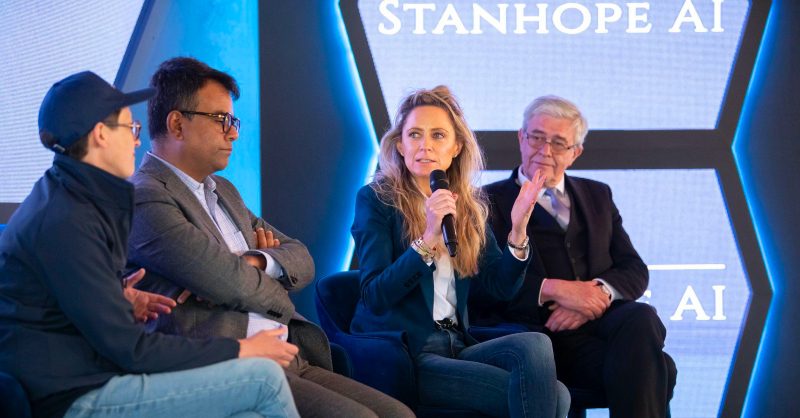
Stanhope AI targets a new era of autonomous drones
UK startup Stanhope AI is drawing on neuroscience to solve one of robotics’ toughest problems: how to make drones and other autonomous systems truly perceive and react to the real world in real time, without relying on cloud-scale compute. The company’s brain-inspired models are designed to run efficiently on the edge, promising smarter, more resilient robots for industry, defence and infrastructure monitoring.
Brain-like models vs traditional AI
Most current drone systems depend on large deep learning models that are power-hungry and brittle when conditions change. By contrast, Stanhope AI is developing architectures that mimic how biological brains process sensory information: highly parallel, event-driven and tolerant to noise.
These models aim to fuse multiple data streams – such as video, lidar and inertial sensors – into a single, continuously updated representation of the environment. That could allow drones to navigate cluttered spaces, track moving objects and adapt to unexpected obstacles with far lower latency and power consumption than conventional computer vision pipelines.
Edge autonomy for risky, high‑value missions
Smarter onboard perception is critical for sectors where connectivity is unreliable or missions are safety‑critical. Industrial inspection, disaster response and defence all demand drones that can make decisions locally without constant human control or a high‑bandwidth link to the cloud.
Stanhope AI argues that its approach can unlock this next wave of autonomy by enabling compact processors to run complex AI algorithms on the vehicle itself. That could reduce the need for expensive ground crews, lower operational risk and open up new use cases such as persistent monitoring of offshore assets or autonomous convoy protection.
Positioning in the global autonomy race
As the US, Europe and Asia race to deploy more autonomous systems, demand is rising for AI that is both explainable and energy‑efficient. Brain‑inspired models sit at the intersection of robotics, neuromorphic computing and defence tech, making Stanhope AI a potential partner for drone manufacturers, sensor makers and government agencies.
If the company can demonstrate robust performance outside the lab, its technology could help shift drones from scripted tools into adaptive teammates – a key step toward safer skies and more capable autonomous fleets.