

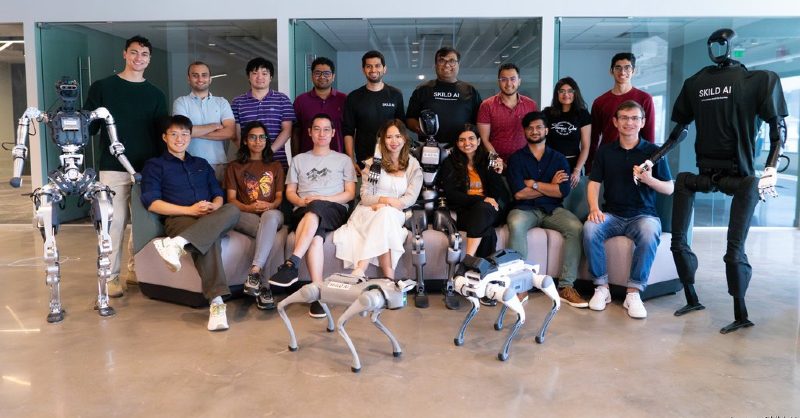
Skild AI lands $1.4 billion to accelerate robotics revolution
Skild AI, a fast-rising robotics company, has secured an impressive $1.4 billion funding round, underscoring growing investor conviction that robotics is approaching a foundational shift. The scale of the capital injection places Skild AI among the most heavily backed players in the emerging wave of intelligent automation, where advanced AI algorithms and adaptive hardware are beginning to converge.
A signal that robotics is entering a new era
The size and timing of this funding round are being read by industry observers as a clear signal that the robotics sector is transitioning from experimental deployments to large-scale, real-world adoption. For years, robots have been confined largely to structured factory settings and repetitive tasks. With the rise of more powerful machine learning, computer vision, and foundation models, companies like Skild AI are aiming to unlock far more flexible and general-purpose capabilities.
Investors are effectively betting that the combination of scalable AI infrastructure and increasingly affordable robotic hardware will allow robots to operate in unstructured environments such as warehouses, retail stores, hospitals, and even outdoor industrial sites. The fresh $1.4 billion in capital gives Skild AI a substantial war chest to accelerate that vision.
Strategic use of the $1.4 billion funding
While the company has not yet disclosed every detail of its roadmap, several priorities are emerging as central to how Skild AI is expected to deploy the funds:
- Scaling AI training and simulation to enable robots to learn complex tasks faster and more safely.
- Expanding robotics platforms that can be adapted to multiple industries, rather than building single-purpose machines.
- Building robust cloud and edge infrastructure so fleets of robots can be monitored, updated, and coordinated in real time.
- Strengthening safety and reliability engineering to meet regulatory and enterprise standards for mission-critical operations.
By focusing on these pillars, Skild AI aims to position itself not just as a hardware manufacturer, but as a full-stack provider of intelligent robotic systems, spanning software, hardware, and data infrastructure.
Why investors see a foundational shift in robotics
The magnitude of this round reflects a broader belief in the market that robotics is at an inflection point similar to the early days of cloud computing or smartphones. Several forces are converging:
- Advances in AI: Breakthroughs in deep learning, reinforcement learning, and multimodal models are giving robots better perception, planning, and control than ever before.
- Falling hardware costs: Sensors, actuators, and compute components continue to become more powerful and less expensive, enabling more capable systems at scale.
- Labor shortages and rising costs: Many industries face persistent labor gaps in physically demanding or repetitive roles, making automation more attractive.
- Enterprise digital transformation: Companies that have already digitized workflows are now ready to integrate physical automation as the next step.
Within this context, Skild AI is positioning its technology as an enabling layer that can adapt to different sectors, rather than being locked into a single niche. That flexibility is a key reason why the company is drawing such substantial funding at this stage.
Potential impact across industries
Logistics and warehousing
In logistics and e-commerce fulfillment, robots powered by Skild AI could handle tasks such as picking, packing, and palletizing with higher speed and accuracy. By combining computer vision with dexterous manipulation, these systems aim to manage a wide variety of items without extensive reprogramming.
Manufacturing and industrial operations
In manufacturing, the company’s technology could support more flexible production lines, where robots can be re-tasked quickly as product designs change. This aligns with the shift toward smart factories and Industry 4.0, where connected machines, real-time data, and predictive maintenance are becoming standard.
Healthcare, retail, and services
Beyond heavy industry, Skild AI is also expected to explore opportunities in sectors such as healthcare and retail. In hospitals, robots could assist with logistics, disinfection, or routine support tasks, reducing the burden on staff. In retail environments, mobile robots might help with inventory checks, shelf restocking, or back-of-house operations.
Technical foundation: AI-first robotics
Unlike traditional industrial robots that rely heavily on pre-programmed routines, Skild AI is part of a new generation of companies building AI-first robotics platforms. These systems are designed to learn from large datasets, simulation environments, and real-world experience.
Key elements of this approach include:
- Simulation-driven training, where robots learn tasks in virtual environments before deployment.
- Continuous learning loops, enabling systems to improve based on operational data from the field.
- Shared models across fleets, so improvements in one environment can be rolled out to many robots.
This architecture has the potential to dramatically shorten development cycles and make robots more adaptable, a core requirement if they are to operate reliably in dynamic, real-world settings.
Challenges and responsibilities ahead
Despite the optimism, the path forward is complex. As Skild AI scales, it will need to address concerns around workforce impact, data privacy, and operational safety. Enterprises and regulators alike are demanding clear frameworks for how robots interact with human workers, how data is stored and processed, and how systems respond in edge cases or failures.
For a company armed with $1.4 billion in fresh capital, expectations will be high. Meeting them will require not only technical excellence but also transparent engagement with customers, policymakers, and the public on the role of advanced robotics in the future of work.
What this means for the robotics ecosystem
The funding round for Skild AI is likely to have ripple effects across the broader robotics and AI ecosystem. Competitors and startups in adjacent fields may find it easier to attract capital as investors seek to build a portfolio of bets in intelligent automation. At the same time, large industrial and technology incumbents may accelerate their own strategies, whether through partnerships, acquisitions, or internal R&D.
As the sector moves into this new phase, the performance of high-profile players like Skild AI will play a significant role in shaping how quickly robots transition from promising prototypes to indispensable tools across the global economy.
For now, the $1.4 billion funding round stands as a clear marker: the race to define the next generation of robotics is very much underway, and Skild AI has firmly placed itself near the front of the pack.