

SAFEs now dominate pre-seed deals — with hidden costs for founders
SAFE notes have become the near-universal instrument for early-stage fundraising, with an estimated 92% of pre-seed rounds now structured using them, according to venture capital insiders. Yet many investors warn that the very tool designed to simplify fundraising is quietly eroding founder control long before a formal priced equity round ever happens.
Created by Y Combinator in 2013, a SAFE (Simple Agreement for Future Equity) was meant to replace complex convertible notes with a clean, founder-friendly contract. Instead of issuing shares immediately, startups promise future equity at a discount or valuation cap when a later round is priced. The documents are short, fast to sign and widely available online — which is exactly why they have become the default for first money in.
However, as rounds get larger and more fragmented, multiple overlapping SAFE agreements can stack into significant, and often unexpected, dilution. Several VCs now argue that founders who rely heavily on SAFEs are losing majority control without realising it until it is too late.
Why founders underestimate dilution from stacked SAFEs
Multiple caps, side letters and informal bridges
In theory, a single modest SAFE round at a sensible valuation cap might be manageable. In practice, pre-seed rounds have become messy. Founders frequently:
- Raise from dozens of small cheques over many months
- Use different caps and discounts for different investors
- Add informal bridge SAFEs when cash runs short
- Ignore a proper cap table model until a lead investor demands one
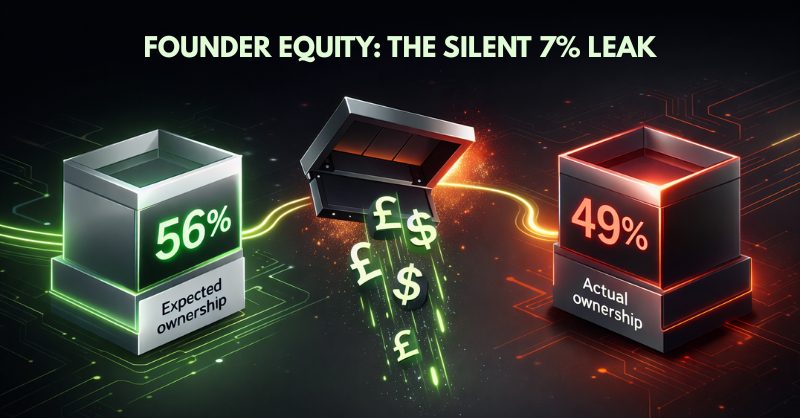
Each new SAFE looks harmless on its own. But when a later seed round finally prices the company, all outstanding SAFEs typically convert at once. The result can be a sudden, sharp drop in the founders’ ownership — sometimes below 50% — at the very moment the company is trying to attract top-tier venture capital.
Several investors say they now routinely meet teams who believe they still own 70–80%, only to discover, after modelling all SAFEs and an option pool, that the true figure is closer to 40–45%.
The psychological trap of “non-dilutive” early money
Part of the problem is perception. Because SAFEs do not immediately issue shares, some founders treat them as if they are not “real” dilution. Early legal templates and blog posts often emphasised speed and simplicity over long-term capital structure planning.
VC partners say this leads to a dangerous mindset: founders feel comfortable raising a little more, then a little more again, telling themselves they will “fix it at the seed round”. By the time they seek a priced round, their future equity is already heavily committed.
How SAFEs can flip control before Series A
Crossing below the 50% threshold
Control in a startup is not just about board seats; it is also about who ultimately holds the majority of common shares and voting power. When founders fall below 50% combined ownership, several things become harder:
- Resisting unfavourable terms in future rounds
- Protecting key employees with competitive stock options
- Blocking unwanted acquisitions or strategic pivots
- Maintaining leverage in negotiations with late-stage growth investors
Investors say they increasingly see companies where stacked SAFEs, an enlarged ESOP (employee stock option pool), and a robust seed round leave founders with a minority stake well before Series A. In some cases, no single founder holds more than 15–20% on a fully diluted basis.
Downstream impact on fundraising and exits
This erosion of control can have knock-on effects:
- Top-tier VCs often prefer founding teams with meaningful skin in the game; over-diluted founders may struggle to attract them.
- Employees can become wary when they see a crowded cap table and limited room for future option grants.
- Acquirers may push for lower valuations if they sense a fragmented shareholder base and misaligned incentives.
Some funds now walk away from otherwise promising deals when they see what one partner calls “cap table carnage” created by poorly managed SAFE rounds.
What venture capital firms advise founders to do differently
Treat SAFEs as real equity from day one
VC investors stress that every dollar raised on a SAFE should be modelled as if it were equity already issued. Founders are urged to build a fully diluted cap table that includes:
- All existing SAFEs, with their caps and discounts
- Any target option pool expansion for future hires
- Expected ownership for a lead investor in the next round
Running this scenario early can reveal whether a planned SAFE raise will push founder ownership below critical thresholds.
Standardise terms and limit fragmentation
Another common recommendation from VCs is to avoid a patchwork of bespoke terms. Instead, founders should:
- Use a single, standard SAFE template for the round
- Keep valuation caps and discounts consistent across investors
- Time-bound the raise, rather than leaving it open indefinitely
This reduces both legal complexity and the risk of unexpected dilution when all instruments convert.
Consider moving to priced rounds earlier
While SAFEs remain effective for very early capital, some investors now encourage teams to move to a modestly priced equity round sooner than they might have in the past. A clean priced round can:
- Force a disciplined discussion about valuation
- Clarify ownership and control for all stakeholders
- Provide a firm basis for future round negotiations
For founders in strong markets or hot sectors such as AI, climate tech or fintech, setting a price early may actually preserve more control than continuing to stack SAFEs at increasingly investor-friendly caps.
A maturing ecosystem rethinks “founder-friendly” instruments
As the startup ecosystem matures, both founders and investors are reassessing how “founder-friendly” SAFEs really are when used at scale. Few dispute that they remain faster and cheaper than traditional convertible notes or full equity rounds. But with 92% of pre-seed deals now relying on them, their systemic effects on control and incentives are coming into sharper focus.
For new founders, the message from experienced VC partners is clear: SAFEs are a powerful tool, not free money. Used thoughtfully, they can accelerate a company’s early trajectory. Used carelessly, they can cost teams the majority stake in the very businesses they set out to build.