

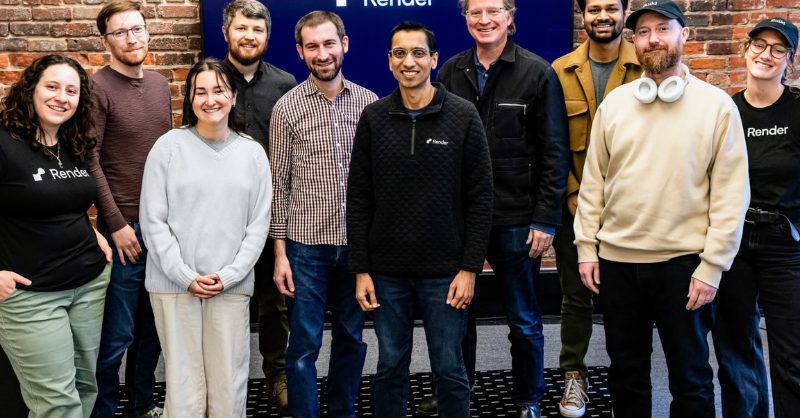
Render’s $100M bet on AI-native cloud infrastructure
Developer-focused cloud platform Render has secured a fresh $100 million funding round, intensifying its bid to become the de facto “AWS for AI developers.” The capital injection positions the company to scale its infrastructure, expand AI-focused services and compete more directly with hyperscale cloud providers that dominate today’s cloud computing market.
While traditional clouds such as AWS, Google Cloud and Microsoft Azure were built for general-purpose workloads, Render is pitching itself as a streamlined, opinionated platform tailored for rapid deployment of AI applications, LLM-backed APIs and high-performance GPU workloads.
Targeting AI developers with a simplified cloud stack
Render aims to remove much of the operational complexity that teams face when building on large cloud platforms. Its product strategy centers on a fully managed stack that abstracts away low-level infrastructure decisions, allowing engineers to focus on models, data pipelines and application logic rather than on networking, scaling policies or cluster configuration.
By offering managed containers, databases, serverless functions and increasingly, access to GPU instances optimized for machine learning and generative AI, the company is betting that simplicity and predictable pricing will resonate with startups and mid-market teams frustrated by the complexity and cost structures of incumbent providers.
Can $100M close the gap with hyperscalers?
The central question for investors and customers is whether a $100 million round is sufficient for Render to compete in a capital-intensive arena where hyperscale data centers, custom AI accelerators and multi-billion-dollar infrastructure budgets are becoming the norm. Rather than matching the giants feature-for-feature, Render is expected to focus on a narrower but fast-growing segment: AI-native teams that value developer productivity over raw breadth of services.
Industry observers note that success will hinge on securing reliable access to high-performance GPUs, maintaining strong uptime and building a robust ecosystem of AI tools, integrations and community support. If it can deliver that combination, the new funding could allow Render to solidify its role as a leading alternative cloud for AI-era software development, even as the broader market remains dominated by the traditional hyperscalers.