

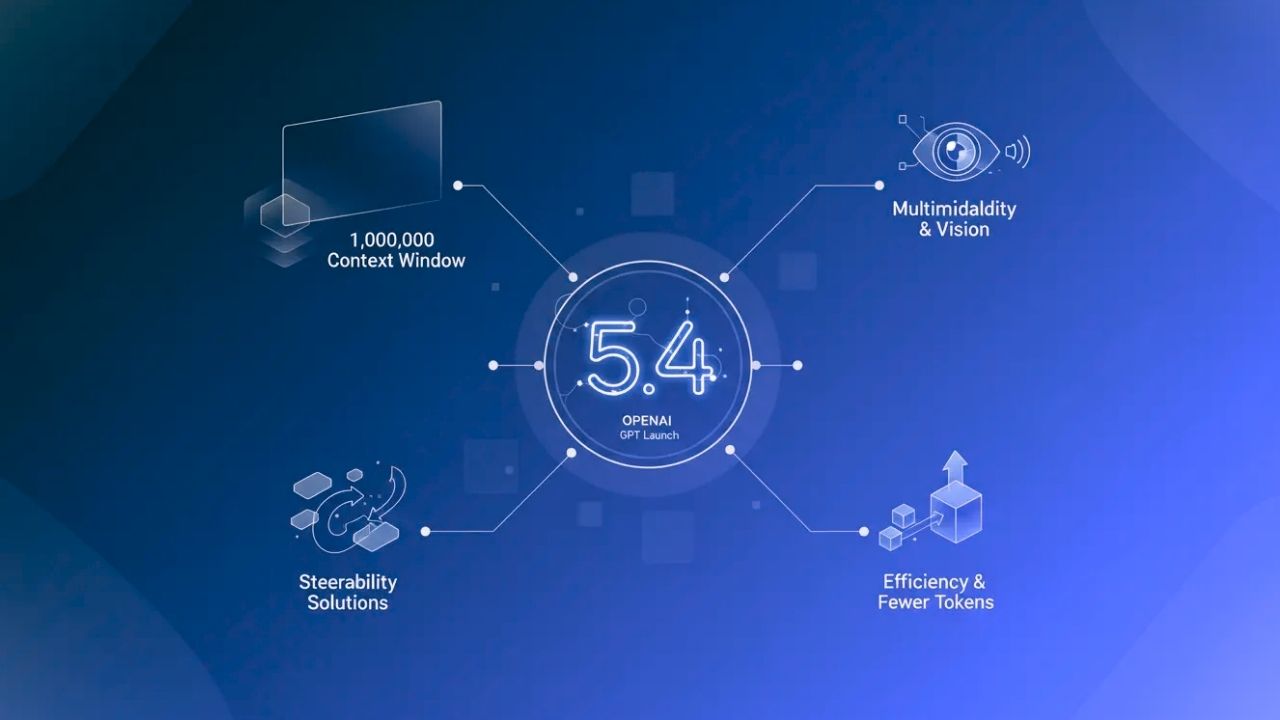
OpenAI has officially launched its GPT-5.4 models, integrating direct desktop navigation and advanced spreadsheet capabilities to streamline enterprise workflows.
SAN FRANCISCO — Just days after deploying the GPT-5.3 Instant architecture, OpenAI has significantly expanded its artificial intelligence portfolio with the release of GPT-5.4. The organization is offering the technology in two distinct tiers: GPT-5.4 Thinking for standard subscribers and GPT-5.4 Pro for complex enterprise requirements.
Both iterations are accessible through the commercial application programming interface and the Codex software development environment. Access to the advanced reasoning tier requires a ChatGPT Pro or Enterprise subscription, while free users will occasionally interact with the system through automated routing protocols.
Direct Desktop Navigation
The most significant technical advancement is the introduction of a native computer use mode. Representatives from OpenAI detailed that the model can actively navigate operating systems much like a human operator. By utilizing libraries such as Playwright, the system can execute keyboard commands and mouse movements in response to visual screen captures.
Performance metrics indicate substantial improvements over the previous GPT-5.2 iteration. On the OSWorld-Verified benchmark, which evaluates desktop navigation, the new architecture achieved a success rate of seventy-five percent, completely surpassing reported human baselines. Similar operational gains were documented across web browsing evaluations like BrowseComp and Online-Mind2Web.
Financial Modeling and Enterprise Integration
Targeting the corporate sector, the developer released dedicated integrations for Microsoft Excel and Google Sheets. These secure plugins embed the analytical capabilities of GPT-5.4 directly into spreadsheet cells, allowing financial teams to automate complex data modeling, comparable analysis, and earnings previews.
The suite seamlessly connects with prominent market data providers, including FactSet, MSCI, Third Bridge, and Moody’s, centralizing internal and external data processing. This aggressive expansion into automated white-collar workflows closely follows similar enterprise product launches from competitors like Anthropic, which recently introduced its Cowork application alongside the Claude models.
Efficiency and Dynamic Tool Retrieval
To manage the expanding ecosystem of digital tools, the system employs a novel tool search mechanism. Instead of processing every available software tool definition upfront, the model retrieves specific operational guidelines only when immediately required. Testing on the MCP Atlas benchmark by Scale demonstrated that this targeted retrieval method reduced token consumption by nearly forty-seven percent on specific tasks while maintaining perfect accuracy.
Industry professionals utilizing early versions of the software have noted marked improvements in daily operations. Daniel Swiecki from the investment firm Walleye Capital reported a significant accuracy increase during internal financial evaluations, attributing the success to superior scenario analysis capabilities. Similarly, Mercor executive Brendan Foody confirmed that the system currently dominates their APEX-Agents testing framework for professional services.
Pricing Structure Adjustments
Despite the efficiency gains, utilizing the application programming interface requires a premium financial commitment. Baseline pricing for the standard tier is set at two dollars and fifty cents per million input tokens, while the professional tier commands thirty dollars for the same volume.
Furthermore, the company has implemented a progressive billing structure, officially doubling the standard rate for any request exceeding two hundred and seventy-two thousand tokens. Corporate spokespersons justified the premium pricing framework by highlighting the massive enhancements in factual reliability, autonomous reasoning, and multi-step workflow execution, noting that the overall response error rate has dropped significantly.