

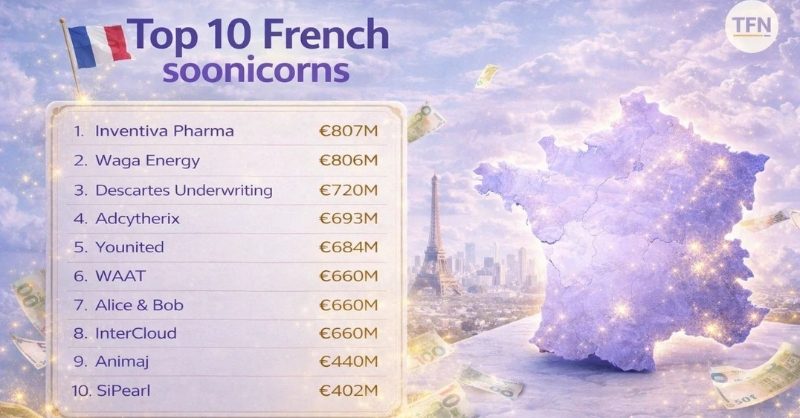
French soonicorns emerge as Europe’s next wave of tech powerhouses
France’s startup ecosystem is entering a decisive phase. In 2025, French startups collectively raised around €8.2 billion across nearly 700 funding rounds, cementing the country’s status as one of Europe’s most dynamic innovation hubs. At the heart of this momentum is a new generation of high-growth companies – the so‑called soonicorns, venture-backed startups on the brink of achieving unicorn status.
As AI, deep tech and digital platforms continue to attract record levels of capital, at least ten French soonicorns are now widely viewed by investors as the most likely to cross the coveted $1 billion valuation threshold in 2026. Their trajectories will help define not only France’s tech story, but also the broader competitiveness of European innovation against the US and Asia.
Why France is producing a new class of soonicorns
France’s rise has not been accidental. Over the past decade, a combination of government incentives, maturing venture capital funds and a critical mass of technical talent has turned Paris and other French cities into fertile ground for ambitious founders.
Policy, capital and talent align
Flagship initiatives such as La French Tech, generous R&D tax credits and targeted public co‑investment have helped derisk early‑stage innovation. At the same time, French and pan‑European growth equity funds are now able to lead larger rounds, reducing the historical dependence on late‑stage US capital.
On the talent side, France’s network of elite engineering schools continues to feed startups with strong technical profiles, especially in machine learning, data science and applied mathematics. Many of the country’s soonicorns are founded or staffed by alumni of institutions such as École Polytechnique, HEC Paris and INRIA.
AI and digital tech dominate the funding landscape
The 2025 funding data highlights a clear shift: capital is concentrating around AI‑native products, digital infrastructure and software‑driven platforms. While sectors such as mobility and fintech remain important, the most aggressive growth is now coming from companies that embed AI algorithms at the core of their business model.
From vertical AI to enabling infrastructure
French soonicorns can broadly be grouped into two categories:
- Vertical AI champions – startups applying generative AI and advanced automation to specific industries such as healthcare, legal services, cybersecurity, retail and logistics.
- Digital infrastructure and platforms – companies building the underlying cloud, data, developer tools and payments layers that enable other businesses to scale.
Investors are particularly drawn to business models with strong recurring revenue, defensible data moats and a clear path to international expansion. This is where France’s soonicorns are starting to look less like local champions and more like genuine global contenders.
Ten French soonicorns to watch in 2026
While valuations and deal terms remain largely private, venture insiders consistently point to a core group of roughly ten French startups as the closest to unicorn status. They are typically late‑stage, have raised multiple large rounds and are reporting rapid growth in annual ARR or transaction volumes.
Across this cohort, several common traits stand out:
- Headquarters in Paris or other major French tech hubs, but with significant hiring in London, Berlin and the US.
- Product‑led growth strategies, with strong self‑serve or API‑driven adoption.
- Strategic use of AI models to enhance productivity, personalization or security.
- Increasing interest from global growth funds and sovereign wealth funds looking for European exposure.
Several of these companies already operate at near‑unicorn valuations on a fully diluted basis. A single large Series D or pre‑IPO round in 2026 could formally tip them over the $1 billion mark.
What this means for European venture capital
The rise of French soonicorns is reshaping the dynamics of European venture capital. Historically, late‑stage capital in Europe has been fragmented and relatively shallow compared with the US. France’s maturing pipeline of high‑growth companies is now giving investors the scale they need to deploy larger tickets domestically.
More competition, more exits, more second‑time founders
As these soonicorns advance toward potential IPOs or trade sales, several structural shifts are likely:
- Increased competition among growth‑stage funds for allocation in French deals, driving up valuations but also standards.
- A stronger pipeline of tech IPOs on European exchanges, improving liquidity for limited partners and founders.
- A new generation of second‑time entrepreneurs who recycle capital and experience into fresh startups, reinforcing the ecosystem.
For global investors, French soonicorns offer exposure to high‑growth AI and software plays at valuations that still often sit below equivalent US comparables.
Challenges on the road to unicorn status
Despite the optimism, France’s soonicorns face real hurdles. Scaling from a national champion to a global category leader requires more than capital. It demands operational discipline, robust governance and the ability to navigate complex regulatory landscapes, particularly in areas such as data privacy and AI safety.
Hiring senior leadership with deep international experience remains a bottleneck for some French companies. Competition for top‑tier product, sales and engineering leaders is fierce, and many still gravitate toward established hubs in the US and UK. Currency fluctuations, shifting interest rates and geopolitical uncertainty could also affect fundraising conditions in 2026.
Why 2026 could be a defining year
With nearly €8.2 billion deployed in 2025 and a robust pipeline of late‑stage companies, 2026 is shaping up as a pivotal year for French tech. Multiple soonicorns are on track to announce sizable rounds, strategic partnerships or expansion into the US and Asia‑Pacific, each of which could crystallize unicorn‑level valuations.
For founders, employees and investors, the stakes are high. If this cohort successfully transitions into sustainable unicorns, it will validate France’s long‑term bet on innovation and position the country as a central pillar of Europe’s digital economy. If even a handful of these soonicorns achieve global category leadership, the impact on jobs, exports and technological sovereignty will be felt far beyond Paris.
What is clear already is that France’s next generation of tech champions is no longer a distant prospect. The soonicorns are here, well‑funded and moving fast toward the global stage.