

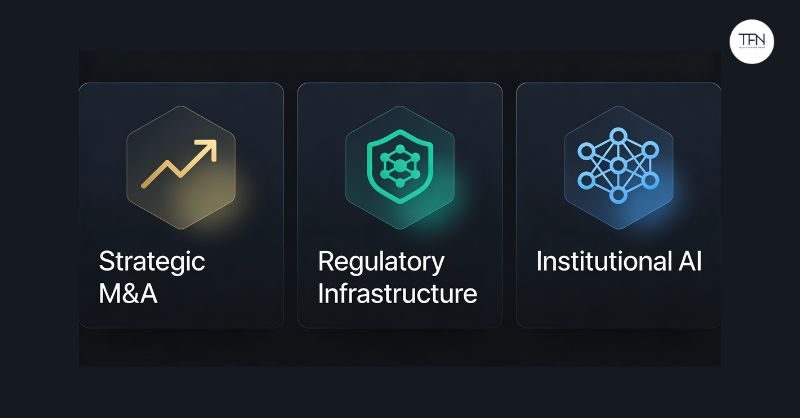
A more selective era for European fintech
By 2026, the European fintech ecosystem is expected to look markedly different from the exuberant, growth-at-all-costs cycle of the late 2010s and early 2020s. Founders, investors and regulators are converging on a new reality: capital is more selective, compliance is non‑negotiable, and the quiet integration of artificial intelligence (AI) is reshaping how financial products are built and delivered.
While Europe remains one of the world’s most active hubs for digital finance, the years ahead are likely to reward disciplined execution, sustainable unit economics and deep regulatory fluency rather than headline‑grabbing valuations. The result is a maturing market in which fewer companies will raise large rounds, but those that do will be structurally stronger.
Funding outlook: disciplined capital and slower growth
The funding environment for European fintech has already cooled compared with the peak years of 2020–2021, and that recalibration is expected to persist into 2026. Rising interest rates, tighter liquidity and a more cautious stance from venture capital funds have pushed investors to scrutinise business models more aggressively.
Instead of backing dozens of look‑alike neo‑banks or payment apps, investors are now prioritising:
- Clear paths to profitability over pure user growth
- Demonstrable regulatory readiness and strong risk controls
- Defensible technology, including proprietary AI models and data
- Vertical specialisation in areas such as SME lending, wealthtech or regtech
For founders, this means that raising capital in 2026 will likely take longer, require more evidence of traction and involve more structured terms. Bridge rounds, down rounds and strategic mergers are expected to remain common, particularly among consumer‑facing fintechs that struggled to convert rapid customer acquisition into recurring, profitable revenue.
Regulation: from headwind to competitive moat
Regulation has always been central to European finance, but by 2026 it will be an even more decisive factor in who wins and who exits the market. Key frameworks such as the Markets in Crypto‑Assets (MiCA) regulation, the Digital Operational Resilience Act (DORA), the revised Payment Services Directive (PSD3), and the emerging EU AI Act are reshaping how fintechs design products, manage data and report risk.
Compliance as strategy, not a checkbox
Rather than treating compliance as a cost centre, leading companies are increasingly turning it into a strategic asset. Start‑ups that embed regulatory requirements into their architecture from day one are finding it easier to partner with incumbent banks, secure licences and scale across borders.
By 2026, European regulators are expected to intensify their focus on:
- Consumer protection in lending, investing and digital assets
- Operational resilience and third‑party risk, especially in cloud‑based infrastructures
- Anti‑money laundering (AML) and know‑your‑customer (KYC) controls
- Transparent, explainable use of AI algorithms in credit scoring and fraud detection
Fintechs that fail to meet these standards will find market access restricted, while those that excel could turn compliance into a moat, offering white‑label solutions or regtech services to other players.
The quiet rise of AI in everyday fintech
Despite the hype cycles surrounding generative AI, the most transformative applications in European fintech are unfolding quietly behind the scenes. By 2026, AI systems are expected to be deeply embedded across the value chain, from underwriting and risk scoring to customer support and transaction monitoring.
Risk, fraud and credit scoring
European fintechs are increasingly deploying machine learning to improve fraud detection and refine credit decisioning. Instead of relying solely on traditional credit bureau data, lenders are integrating alternative signals such as cash‑flow patterns, invoice histories and behavioural data, while navigating strict EU privacy rules.
Advanced AI algorithms can process these data sets in real time, flagging anomalies and reducing false positives. This not only cuts losses but also allows more precise risk‑based pricing, potentially widening access to credit for under‑served customers and small businesses.
Automation and customer experience
On the front end, AI‑powered chatbots and virtual assistants are handling a growing share of routine customer interactions, from balance queries to card‑blocking and dispute initiation. By 2026, many European fintechs will have adopted hybrid models in which AI tools manage first‑line support, while human agents focus on complex, high‑value cases.
Back‑office automation is also accelerating. AI workflows are being used to streamline onboarding, document verification, compliance checks and reconciliation, cutting operational costs and enabling leaner teams to handle larger volumes.
Key segments to watch by 2026
Not all parts of the fintech landscape will evolve at the same pace. Several segments stand out as particularly dynamic in the European context.
Payments and embedded finance
The European payments market is moving beyond simple card and wallet innovation towards full‑stack embedded finance. Technology platforms are integrating lending, insurance and accounts directly into software used by retailers, logistics firms and B2B marketplaces.
By 2026, many European consumers may interact more with financial services through non‑financial brands than through traditional banks or standalone fintech apps, even if regulated institutions still sit in the background.
Digital assets and tokenisation
Under the guardrails of MiCA and related frameworks, European players are exploring security tokenisation, stablecoins and on‑chain settlement for capital markets. Rather than speculative trading, the emphasis is shifting toward institutional‑grade infrastructure, compliant custody and programmable assets.
Fintechs that can bridge traditional finance and blockchain‑based rails in a regulated, transparent way are likely to attract interest from both banks and asset managers.
Green and impact‑focused fintech
Europe’s policy focus on ESG and climate transition is spawning a new wave of fintechs that specialise in carbon accounting, sustainable investing and green lending. By 2026, these firms are expected to play a greater role in helping companies and individuals track emissions, align portfolios with climate goals and access incentives for sustainable projects.
Consolidation, partnerships and the road ahead
As the sector matures, consolidation is likely to accelerate. Smaller or undifferentiated players may seek exits through trade sales, while stronger fintechs pursue strategic acquisitions to expand into new verticals or geographies. Partnerships between fintechs and incumbent banks will deepen, driven by open‑banking mandates and the need for robust balance sheets and licences.
By 2026, European fintech will be less about disruptive slogans and more about durable infrastructure: compliant, AI‑enabled platforms that quietly power payments, lending, wealth management and risk services across the continent. The winners will be those that combine technological sophistication with regulatory credibility and disciplined financial management in a funding environment that no longer forgives weak fundamentals.