

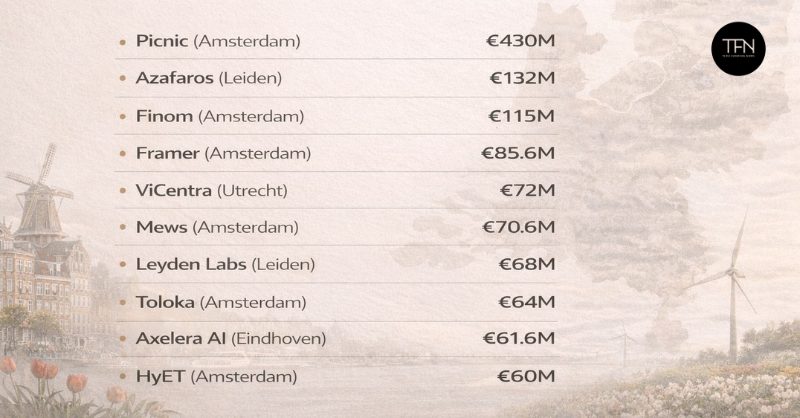
Dutch startups lock in €1.3B as 2026 growth race accelerates
In a landmark funding streak that underscores the Netherlands’ rise as a European innovation powerhouse, a cohort of Dutch startups has collectively secured around €1.3 billion across just 10 major deals. The capital injection, highlighted by tech outlet TFN, positions these companies to aggressively scale products, teams and international operations ahead of 2026, a year many investors see as a decisive moment for European tech leadership.
Why this funding wave matters for the Dutch ecosystem
The Netherlands has long been recognised for its strong startup foundations, but the latest figures point to a decisive shift from early-stage experimentation to large-scale execution. Investors are backing Dutch companies not only for their technical talent, but also for their ability to turn prototypes into global businesses.
Several of the 10 deals fall into late-stage rounds, reflecting strong confidence in revenue traction and market fit. For founders, this means more runway to expand internationally; for the broader ecosystem, it signals a maturing market that can consistently produce high-value scale-ups rather than isolated success stories.
Key sectors attracting the biggest cheques
While individual deal details vary, the pattern of investment reveals clear strategic priorities among European and global investors.
Deep tech and AI at the core
Multiple Dutch ventures in deep tech and AI algorithms have attracted large tickets, reflecting a broader shift in European funding from consumer apps to complex, defensible technologies. These startups are working on everything from advanced semiconductors and quantum computing components to industrial automation and predictive data analytics.
Backers see the Netherlands’ strong engineering universities and research institutes as a competitive advantage. The country’s tight collaboration between academia, government and industry is helping to translate lab breakthroughs into scalable products.
Climate tech and energy transition
Another major slice of the €1.3 billion is flowing into climate tech, particularly in areas such as renewable energy, grid optimisation, and electrification of transport and industry. Dutch startups are building solutions for offshore wind integration, smart charging infrastructure and low-carbon logistics, aligning closely with EU climate targets for 2030 and 2050.
Investors are increasingly viewing climate solutions as both a regulatory necessity and a long-term growth opportunity, and Dutch companies are positioning themselves as key suppliers of infrastructure and software for the European energy transition.
Fintech, logistics and digital infrastructure
The Netherlands’ historic strength in trade and finance is also reflected in the deal flow. Several of the 10 funded companies operate in fintech, payments, and digital infrastructure for cross-border commerce and supply chains. With Europe tightening rules around compliance, data protection and open banking, Dutch startups are building platforms that help banks, retailers and logistics operators stay ahead of regulation while cutting operational costs.
Who is backing the Dutch scale-up surge?
The €1.3 billion figure is not driven by domestic capital alone. The deals involve a mix of Dutch institutional investors, European growth funds and global venture capital and private equity firms, many of which have increased their allocation to continental Europe after years of focusing on the US and UK.
Large international funds are particularly attracted by the Netherlands’ predictable regulatory environment, strong English-speaking workforce and central location within the EU single market. At the same time, Dutch pension funds and family offices are gradually becoming more active in late-stage tech, adding local stability to the cap tables.
Policy tailwinds: how the Netherlands is sharpening its edge
The recent funding streak also reflects deliberate policy choices. The Dutch government has been working to streamline startup visas, improve access to R&D incentives and expand co-investment programmes aimed at scaling promising ventures. Regional hubs like Amsterdam, Rotterdam, Eindhoven and Delft have each carved out specialist niches, from semiconductor design to maritime innovation and urban mobility.
These initiatives are designed to prevent promising Dutch companies from relocating abroad for growth capital, a recurring risk in smaller markets. By making it easier to raise large rounds domestically or within the EU, policymakers hope to keep strategic technologies and jobs anchored in the Netherlands.
What 2026 could look like for Dutch tech
With €1.3 billion already committed across 10 standout deals, 2026 is shaping up as a pivotal year. Several of the funded companies are expected to reach the scale required for potential IPOs or major M&A events, which could recycle capital back into the ecosystem and create a new generation of angel investors and repeat founders.
Analysts expect more Dutch startups to hit nine-figure revenue milestones, expand engineering hubs across Europe and North America, and deepen partnerships with global corporates. If current momentum continues, the Netherlands could strengthen its position alongside Germany, France and the Nordics as one of Europe’s primary innovation engines.
The role of media and transparency in the next phase
As the ecosystem matures, the way information is shared with the public and with investors is becoming increasingly important. Outlets like TFN and digital-native brands such as Dailyza are playing a key role in tracking large funding rounds, highlighting emerging founders and explaining complex topics like data privacy, cookie consent and personalised advertising in clear language.
This visibility matters: it helps international capital discover Dutch opportunities, gives policymakers feedback on which regulations support or hinder innovation, and allows citizens to understand how new technologies and business models will affect jobs, security and everyday life.
With billions now flowing into Dutch innovation and a critical mass of scale-ups preparing for global expansion, the Netherlands is no longer just a promising startup scene. It is becoming a strategic node in Europe’s next wave of technology and climate-driven growth, and the latest €1.3 billion in 10 deals is a strong signal of what is still to come by 2026.