

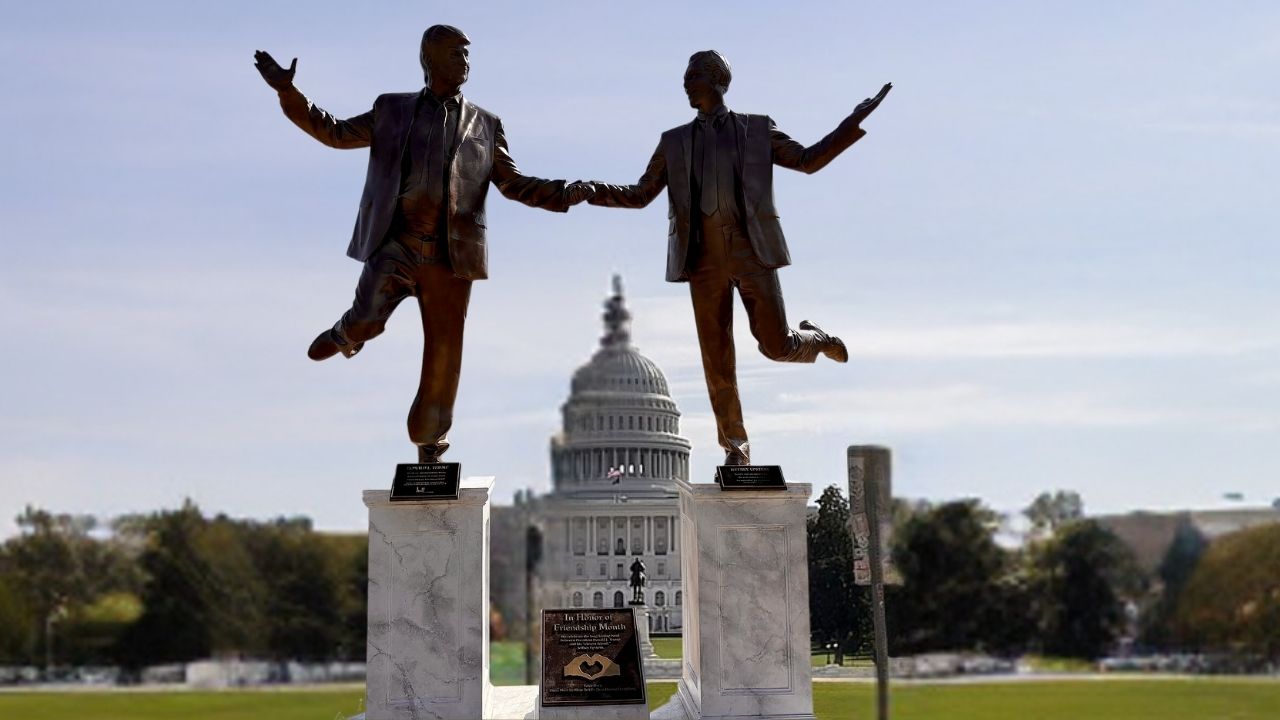
A towering statue of Donald Trump and Jeffrey Epstein repeatedly emerged in Washington, sparking fierce debates over free speech and presidential accountability.
The political landscape of the United States witnessed a highly unusual intersection of satirical art and federal law enforcement during the autumn months of the current year. A massive, twelve-foot sculptural installation portraying the incumbent president, Donald Trump, locked hand-in-hand with the late convicted sex offender, Jeffrey Epstein, mysteriously materialized at the eastern edge of the National Mall. Positioned directly across from the iconic United States Capitol Building in downtown Washington, the provocative artwork immediately generated significant public discourse regarding historical associations, censorship, and the boundaries of protected political expression. The temporary monument served as a stark physical reminder of the unresolved controversies surrounding the executive branch.
Composition and Satirical Intent
Constructed primarily from industrial foam, synthetic resin, sculpted wood, and reinforced wire, the towering figures were meticulously coated in a faux-bronze finish to mimic the aesthetic of traditional, dignified historical monuments. The artists positioned Donald Trump and Jeffrey Epstein balancing on single legs, grinning enthusiastically in a shared, mid-skip frolic. Rather than relying on traditional political rhetoric, the installation utilized heavy visual irony to convey its message.
Engraved plaques affixed to the faux-marble base sarcastically commemorated a fictitious friendship month, praising the supposedly enduring bond between the politician and the disgraced financier. Additional inscriptions indirectly referenced past birthday correspondence between the two men, wishing the recipient a future inevitably filled with wonderful secrets.
The Anonymous Architects
Responsibility for the controversial installation was quickly claimed by an anonymous, underground art collective operating under the pseudonym The Secret Handshake. This particular group has established a noticeable reputation for deploying guerrilla-style, anti-establishment sculptures throughout the federal capital over the past twelve months.
Previous installations credited to the collective include a satirical bronze replica of a desk belonging to former legislative leader Nancy Pelosi, complete with office supplies and a sculpted excrement emoji, as well as a golden avian figure perched atop a gilded television monitor broadcasting repetitive clips of the current president dancing. The group maintains that their primary objective is to utilize dark humor and physical art to force uncomfortable political conversations into the highly visible public square.
The Pre-Dawn Federal Crackdown
The logistical history of the installation proved to be as dramatic as its visual subject matter. Through the assistance of a veteran location manager named Carol Flaisher, the art collective successfully secured a legitimate, multi-day display permit from the National Park Service. The official documentation explicitly stipulated that the artists must receive a twenty-four-hour written notification prior to any forced removal of the property.
However, in the early morning hours of September the twenty-fourth, multiple unmarked vehicles belonging to the United States Park Police arrived at the site. Disregarding the notification clause, federal officers rapidly dismantled the sculpture in the darkness, physically separating the clasped hands and ripping the figures from their podiums. Law enforcement representatives later justified the abrupt removal to news organizations like CBS and NPR by claiming the structure violated height restrictions outlined in the permit, though they initially failed to provide documentation supporting this claim to the civilians present on the scene.
Digital Defiance and Public Domain
Following the midnight confiscation and subsequent damage to their physical artwork, the creators initiated a modern, digital counter-offensive. Recognizing that federal authorities could easily confiscate a physical object, the collective decided to decentralize the protest immediately.
They uploaded highly detailed, three-dimensional digital rendering files of the sculpture to the popular maker platform Printables. By officially waiving all copyright claims and releasing the files into the public domain under a creative commons license, the group encouraged citizens across the globe to utilize their own manufacturing equipment to reproduce the monument at home. The artists publicly declared that while the government could destroy a single physical statue, they could not eradicate the underlying digital concept.
Bureaucratic Maneuvering and the Triumphant Return
Despite the severe structural damage inflicted upon the foam and resin figures, the anonymous collective managed to recover the broken pieces and execute extensive repairs. The artists then engaged in a tense bureaucratic struggle with the Department of the Interior to secure a new placement authorization.
Representatives for the group discovered a specific legal loophole regarding First Amendment demonstration applications, which automatically granted permission if federal authorities failed to issue a formal denial within a specific timeframe. Leveraging this administrative technicality just prior to a massive federal government shutdown, the fully restored sculpture, newly retitled to question why the two figures could no longer be friends, was triumphantly re-erected on the National Mall in early October.
Historical Context and Executive Accountability
The fierce determination to keep the sculpture in the public eye stems from deeply rooted frustrations regarding governmental transparency. The artwork specifically targets the historical relationship between the two men, which the current administration has repeatedly attempted to minimize. Official statements from the executive branch insist that the friendship effectively ended decades ago following a dispute involving poached employees at the Mar-a-Lago estate in Florida.
However, public anger was recently reignited when the administration officially announced in July that it would not pursue further investigations or release additional classified documents pertaining to the expansive criminal network formerly operated by the late financier in New York and beyond. The collective asserts that the sudden, aggressive removal of their artwork perfectly mirrors the broader administrative strategy of suppressing uncomfortable truths and silencing political dissent.
Cultural Impact and Media Reception
The persistent reappearance of the monument garnered massive attention across national media syndicates and late-night television programs. Prominent television host Stephen Colbert dedicated a segment of his broadcast to the controversy, sarcastically praising federal police for protecting constitutional rights for a fraction of a day, while comparing the situation to the recent federal pressures exerted upon the Federal Communications Commission regarding the broadcasting rights of the ABC network and commentator Jimmy Kimmel.
Following the expiration of its final federal permit, the sculpture embarked on a localized tour, eventually finding a temporary home outside the famously progressive Busboys and Poets venue in the northwestern quadrant of the city. Ultimately, the physical artwork succeeded in its primary mission, functioning as a highly effective, undeniable catalyst for a sustained national conversation regarding power, historical memory, and the fragility of free expression.