

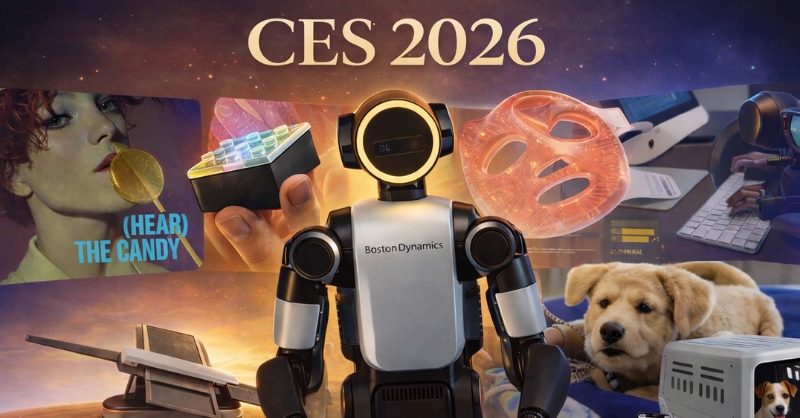
CES 2026 pushes the boundaries of everyday tech
The 2026 edition of the Consumer Electronics Show in Las Vegas has turned speculative science fiction into product demos, with exhibitors unveiling brain-stimulating lollipops, semi-autonomous solar robots for Mars missions, and domestic robots that judge how well you clean your home. The show underscores how quickly neurotechnology, robotics, and space tech are converging into consumer-facing experiences.
Lollipops that play music directly in your brain
One of the most talked‑about concepts on the show floor is a new class of sensory gadgets that look like candy but behave like wearable tech. These so‑called “music lollipops” use targeted neural stimulation and bone conduction principles to create the perception of sound without traditional speakers or headphones.
Instead of broadcasting audio through the air, the device transfers carefully modulated vibrations through the mouth and jaw. These signals are then interpreted by the auditory system as sound, effectively making the user feel as if music is playing “inside” their head. Exhibitors claim the approach can deliver immersive audio while keeping ears free and the environment quiet.
Behind the playful form factor is a serious wave of research in brain–computer interfaces and multi‑sensory experiences. Startups at CES argue that such devices could support accessibility use cases for people with hearing loss, enable silent media consumption in shared spaces, and eventually sync with AR and VR platforms for more convincing virtual environments.
Regulatory questions remain significant. Because these devices interact with the nervous system, they will likely attract scrutiny from health authorities and privacy regulators. Experts in digital rights warn that any system capable of influencing perception could be repurposed for targeted advertising or even subtle behavioral nudging if strong safeguards are not enforced.
Mars solar bots preview the future of off‑world maintenance
Space‑focused exhibitors at CES 2026 are using the event to show how terrestrial robotics can be adapted for extraterrestrial work. Prototype “Mars solar bots” on display resemble rugged, low‑slung rovers equipped with articulated arms and advanced computer vision systems. Their mission: automatically clean, inspect, and reposition solar panels in harsh planetary environments.
Engineers behind the prototypes emphasize that power reliability is one of the biggest constraints on long‑duration missions. Dust accumulation on solar arrays has already shortened the life of multiple Mars rovers. Semi‑autonomous robots that can clear panels, track the sun, and diagnose faults could extend mission lifetimes and reduce the need for direct astronaut intervention.
These bots integrate AI navigation algorithms trained on simulated Martian terrains, combining lidar, stereo cameras, and thermal sensors to avoid obstacles and optimize their routes. While their first destination may be Mars, manufacturers insist the same platforms could be deployed in remote deserts, polar research stations, and large‑scale solar farms on Earth.
Space agencies and private launch providers are closely watching the sector. As competition in commercial space intensifies, any technology that cuts maintenance costs or increases reliability could become a strategic asset. At the same time, civil society groups are beginning to ask how far autonomous systems should be allowed to operate in critical infrastructure without human oversight.
Robots that rate your household chores
Back on Earth, another set of CES demos is turning domestic labor into something like a quantified sport. Several consumer electronics brands are showing home robots that not only vacuum or mop, but also evaluate how clean a room is and provide a numeric “chore score.”
Using a combination of AI vision models, depth sensors, and object recognition, these robots can detect clutter, dust, and streaks on surfaces. Some systems generate a heatmap of missed spots, while others sync with smartphone apps to gamify housework with badges, streaks, and shared leaderboards for families or roommates.
Manufacturers pitch this as a way to reduce arguments over chores and encourage more equitable distribution of domestic work. Parents can assign tasks and receive automated reports; tenants can document cleanliness when moving in or out; short‑term rental hosts can verify that properties meet agreed standards.
Yet the same data‑collection capabilities raise privacy and labor concerns. Because these devices map interiors in detail, they can reveal sensitive information about living conditions, possessions, and daily routines. Consumer advocates are calling for strict limits on how chore data, images, and room maps can be stored, shared, or monetised by brands and third‑party partners.
Convergence of AI, sensors and entertainment
Taken together, brain‑music lollipops, Mars solar bots, and chore‑rating robots illustrate a broader trend at CES 2026: the embedding of advanced AI and dense sensor networks into objects that once seemed mundane. Entertainment, home care, and space exploration are no longer separate silos; they share common stacks of machine learning, edge computing, and human–machine interface design.
Analysts note that this convergence is accelerating because of maturing agentic AI workflows—systems that can autonomously plan and execute multi‑step tasks. The same underlying technology that lets a robot audit your living room can, in principle, coordinate fleets of solar bots on Mars or tune the sensory output of a neural lollipop in real time.
For investors and policymakers, CES 2026 is a reminder that the next wave of consumer electronics will not simply be faster or thinner versions of existing devices. Instead, it will blur the line between the physical and digital, the playful and the clinical, the domestic and the interplanetary. How societies choose to regulate, adopt, or resist these innovations will shape not only future markets, but also how people experience their own bodies, homes, and planetary environment.