

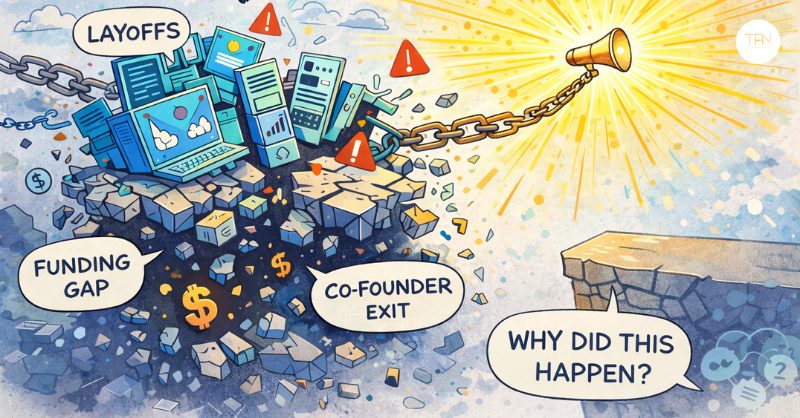
AI startups are shipping strong tech but weak stories
Artificial intelligence may be the most hyped sector in tech, yet many AI startups quietly sabotage themselves before they ever reach scale. The problem is not always the AI models, the data pipelines or the product roadmap. Increasingly, investors and customers point to something more basic: broken communication.
From vague websites and jargon-heavy decks to evasive answers on safety and compliance, communication failures are becoming a primary reason AI ventures stall at seed or Series A. In a market where every week brings a new model launch or funding announcement, the ability to explain clearly what you do, why it matters and why it is safe is now a competitive moat.
1. Hiding behind jargon and buzzwords
Why technical founders default to complexity
Many AI companies are led by deeply technical founders. They are fluent in transformer architectures, vector databases and RLHF, but struggle to translate that expertise into language a CFO or general counsel can act on.
Pitch decks and websites often lean on phrases like enterprise-grade AI platform or next-generation LLM infrastructure without ever answering three basic questions:
- What concrete problem do you solve?
- For which specific customer segment?
- With what measurable business outcome?
When communication is overloaded with buzzwords, non-technical decision-makers tune out. They hear risk, not opportunity.
The cost of unclear value propositions
Investors report passing on otherwise promising AI startups because the team could not articulate a clear path from technology to revenue. Procurement teams in large enterprises raise similar concerns: they cannot justify adopting a tool they cannot explain internally.
The result is a paradox. Startups that are strongest technically often appear weakest commercially, simply because their communication fails to bridge the gap between the lab and the boardroom.
2. Overpromising capabilities and underplaying limits
The temptation to claim “AGI in a box”
In a crowded AI startup landscape, some founders overstate what their systems can actually do. Marketing copy implies fully autonomous decision-making where, in reality, there is a brittle workflow with heavy human oversight.
This misalignment shows up as:
- Claims of near-perfect accuracy without clear benchmarks or test data
- Ambiguous language that blurs the line between automation and augmentation
- Silence on known limitations such as hallucinations or domain gaps
Trust collapses when reality meets hype
When pilots fail to match the promise on the slide, enterprise buyers lose confidence quickly. In regulated sectors like healthcare, finance or defence tech, a single overhyped claim can end a relationship.
Investors, too, are increasingly wary. Many now probe deeply into model performance, edge cases and evaluation methodology. If founders cannot speak plainly about limitations, or appear evasive when challenged, trust erodes.
Ironically, transparent communication about what an AI system cannot do often strengthens credibility. Clear boundaries signal maturity and an understanding of real-world deployment risks.
3. Ignoring governance, safety and compliance questions
Customers want more than a demo
Enterprise buyers no longer ask only, What does it do?. They now ask:
- How do you manage data privacy and security?
- What is your approach to AI safety and model governance?
- Can we audit your training data and evaluation metrics?
Many early-stage AI startups have thought about these issues but have not packaged their answers into clear, reusable communication assets: policy pages, whitepapers, risk matrices or compliance one-pagers.
Silence looks like negligence
When a startup cannot clearly explain how it handles GDPR, data residency, IP ownership or bias mitigation, risk officers assume the worst. Deals stall in legal review, or never make it that far.
The bar is rising fast. New regulations, from the EU AI Act to sector-specific guidance, are pushing buyers to demand documented safeguards. Startups that communicate proactively about governance gain a structural advantage over those that treat it as an afterthought.
4. Misaligned messaging across channels and teams
Different stories for investors, customers and press
Another recurring failure is inconsistency. The story told to VCs in a funding pitch often differs from what appears on the website, which in turn differs from what sales teams say in calls.
This shows up as:
- A deck that positions the company as a horizontal AI platform, while the website advertises a narrow vertical tool
- Press releases emphasizing bold societal impact, while contracts describe a modest workflow assistant
- Support teams discovering features from blog posts rather than internal docs
Why inconsistency kills credibility
Investors triangulate information from multiple sources: your LinkedIn, product documentation, customer references and media coverage. If each channel suggests a different business, doubts grow about focus and execution discipline.
Internally, misaligned messaging leads to fragmented priorities. Product, sales and marketing pull in different directions, slowing down decision-making and confusing customers.
5. Underinvesting in communication talent and process
“We’ll hire marketing after Series A”
A common mistake is delaying strategic communication hires. Many AI teams operate for years without a dedicated head of marketing, product marketer or even a content lead. Founders juggle fundraising, hiring and product while treating communication as a side task.
The consequences are predictable:
- Fragmented messaging written ad hoc by whoever has time
- Technical documentation that is accurate but unreadable to buyers
- No cohesive narrative about the companys mission, roadmap or differentiation
Communication as part of the core stack
Leading AI companies increasingly treat communication as part of the core product. They:
- Bring in senior communicators early, alongside engineering and product leaders
- Develop a shared language for describing models, features and risk controls
- Train engineers and sales teams in how to talk about AI capabilities and limitations consistently
This is not about spinning a better story; it is about making complex systems legible to the people who must approve, buy and use them.
How AI startups can fix their communication gap
Translate technology into business outcomes
Every AI startup should be able to express its value in one clear sentence that references a specific customer, problem and outcome. For example: We help European banks cut manual KYC review time by 60% using explainable document-understanding models.
This kind of statement connects AI technology directly to ROI, while hinting at compliance awareness (explainable) and geography-specific regulation.
Codify safety and governance communication
Founders should work with legal and security experts to create clear, non-legalese explanations of how they handle:
- Data collection, storage and deletion
- Model training, evaluation and monitoring
- Bias, fairness and human oversight
These explanations should be consistent across sales decks, security questionnaires, website FAQs and investor materials.
Invest early in narrative and messaging
As markets mature, the winners in AI will not be those with the most parameters, but those that combine strong technology with a story that customers, regulators and the public can understand and trust.
For AI startups, communication is no longer a cosmetic layer added after the product is built. It is infrastructure. Those that treat it with the same rigor as their AI infrastructure are far more likely to secure funding, close enterprise deals and build durable brands in an increasingly skeptical market.