

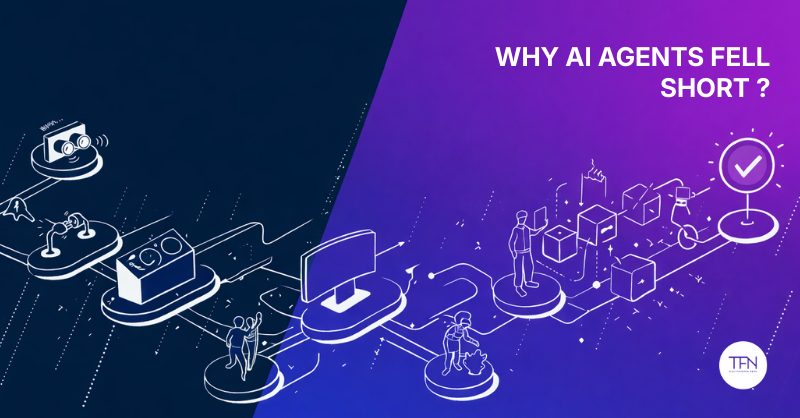
Enterprises Spent Big on AI Agents, but Results Lag
Over the past two years, large enterprises have invested aggressively in AI agents to automate workflows, cut costs and boost productivity. Yet a growing share of leaders now admit the returns are underwhelming. Recent boardroom surveys show that around 81% of CEOs say their AI agent initiatives have not scaled beyond pilots or isolated use cases.
Despite impressive demos and proof-of-concept projects, many companies are stuck in experimentation mode. The promised transformation of customer service, operations and knowledge work has largely failed to materialise at enterprise-wide scale.
Why the AI ‘Value Loops’ Broke
Analysts point to broken value loops as a core reason for disappointing outcomes. In many deployments, AI agents operate as disconnected tools rather than as components in a closed feedback system that continuously learns from outcomes.
Data is often fragmented across legacy systems, making it difficult for AI models to access reliable, real-time information. Human oversight is either too loose, creating trust issues, or too rigid, slowing agents down and eroding efficiency gains. As a result, AI agents struggle to move from isolated tasks to orchestrating end-to-end business processes.
The Rise of Trusted Autonomy
Experts argue that the next phase of adoption depends on building trusted autonomy into AI systems. This means combining strong governance, transparent AI policies and continuous monitoring with clear rules for when agents can act independently and when humans must stay in the loop.
Leading enterprises are now focusing on auditable decision trails, robust risk management and role-based controls that define the exact scope of each AI agent. Rather than chasing generic automation, they are targeting high-value, well-bounded workflows where trust can be measured and improved over time.
What Will Win in 2026
Looking ahead to 2026, industry observers expect winning strategies to prioritise tightly integrated AI platforms, shared data foundations and outcome-based metrics. Companies that design AI agents as part of a measurable value loop — from data collection to decision, action and feedback — are most likely to unlock sustainable impact.
As boards push for tangible returns, the focus is shifting from experimental chatbots to production-grade, trusted autonomous systems that can operate safely at scale across the enterprise.