

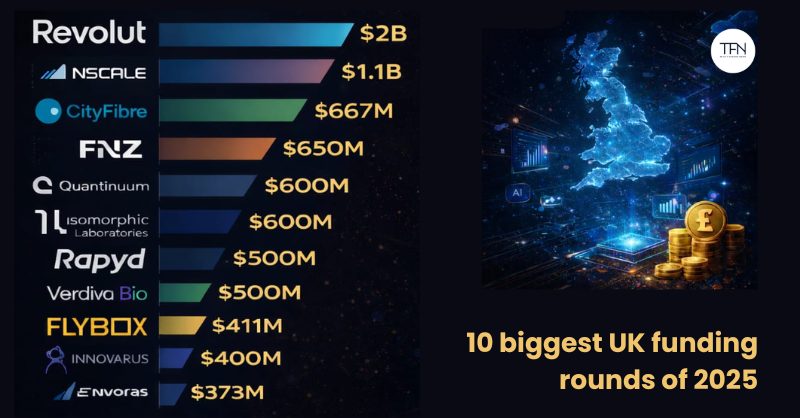
Dailyza analysis of a year-end roundup from TFN shows the UK’s 10 biggest funding rounds of 2025 collectively exceeded $6 billion, underscoring how capital is concentrating into fewer, larger bets across the country’s tech ecosystem. The list spans categories from fintech to quantum computing, reflecting both the UK’s breadth of innovation and investors’ preference for scale-ready businesses with defensible technology.
While early-stage funding has remained selective, the biggest rounds reveal where conviction is strongest: infrastructure-heavy plays (AI compute, data, security), regulated profit pools (banking, payments, insurance), and deeptech platforms with long time horizons (quantum, advanced materials, next-gen semiconductors). The headline number—more than $6 billion across just 10 transactions—also hints at a market where companies that can demonstrate traction, enterprise adoption, or strategic national importance are still able to command outsized checks.
Why 2025’s UK megadeals matter
Megadeals are not just vanity milestones. They shape hiring, M&A, and the competitive landscape for years. In 2025, the UK’s largest rounds acted as a proxy for what investors believe will define the next cycle of growth: scalable financial platforms, AI-native products, and deeptech breakthroughs that can anchor new industrial capabilities.
In practical terms, a $200 million-plus raise can move a company from “promising” to “category shaper.” It enables global expansion, acquisitions, and long-term R&D—especially critical in sectors like quantum where commercialization timelines are longer and the cost of talent and equipment is high.
From fintech to quantum: what the spread says about UK strengths
The 2025 top-10 mix points to a UK ecosystem that is increasingly bifurcated: consumer and enterprise platforms that scale quickly on software economics, and capital-intensive deeptech companies building foundational computing and security layers. The presence of both in the same top tier suggests the UK is not relying on a single narrative, such as consumer apps or marketplace models, to attract large checks.
Fintech remains a magnet for large checks
The UK’s reputation as a global fintech hub continues to translate into large fundraising rounds. London’s density of financial institutions, regulators, and experienced operators makes it easier for startups to pilot products, secure partnerships, and hire compliance and risk talent—advantages that are hard to replicate elsewhere.
Investors have also become more disciplined about what “good” looks like in fintech after the boom-and-bust years. The biggest rounds tend to favor companies with clear unit economics, diversified revenue, and pathways to profitability—particularly those that can serve both consumers and businesses, or that provide infrastructure for other financial products.
AI and compute infrastructure are rising priorities
Alongside fintech, 2025’s largest rounds highlight growing investor appetite for AI infrastructure—the tools and platforms that make AI systems reliable, secure, and deployable in real-world environments. As enterprises move from experimentation to production, demand increases for data governance, model monitoring, cybersecurity, and scalable compute access.
This shift also reflects a strategic reality: AI winners may not only be front-end applications, but also the companies supplying the “picks and shovels” that enable AI adoption across regulated industries such as finance, healthcare, and government procurement.
Quantum signals a long-term national and industrial bet
The appearance of quantum computing among the UK’s biggest 2025 rounds is notable because it indicates sustained confidence in deeptech despite broader market caution. Quantum companies typically require significant capital for specialized hardware, research talent, and multi-year development cycles—meaning investors backing them are often positioning for strategic outcomes rather than quick exits.
For the UK, quantum is also tied to industrial policy and national competitiveness. Large rounds in this space can catalyze supply chains, university spinouts, and partnerships with defense, telecoms, and critical infrastructure providers.
What’s driving the “bigger but fewer” funding pattern
The concentration of more than $6 billion into 10 rounds fits a broader global trend: capital is flowing to companies that can prove resilience under tighter market conditions. Several factors appear to be reinforcing this dynamic in the UK:
- Higher bar for late-stage funding: Investors are prioritizing businesses with measurable traction, strong retention, and credible paths to profitability.
- Regulatory and compliance advantage: UK startups that can navigate financial regulation or security requirements become more attractive to enterprise buyers and investors.
- Strategic scarcity: In areas like quantum and advanced AI tooling, there are fewer credible teams, so capital clusters around the leaders.
- Globalization of rounds: UK companies increasingly raise from international funds, expanding the pool of available capital for the strongest performers.
Implications for founders, investors, and the UK tech economy
For founders, the message is mixed. The top of the market is open for companies that can demonstrate category leadership, but the middle remains competitive and selective. Teams may need to show clearer differentiation, stronger distribution, and tighter financial discipline to reach the scale where megadeals become possible.
For investors, the year’s biggest rounds highlight the importance of underwriting both technology and execution. In fintech, that means risk management, compliance, and sustainable customer acquisition. In AI and quantum, it means defensibility, talent density, and credible go-to-market plans that translate research into enterprise value.
For the UK economy, these large rounds can be a tailwind—supporting high-skilled jobs, exportable products, and a deeper bench of experienced operators. But they also raise questions about whether the ecosystem is producing enough breakout companies beyond London and whether later-stage capital will remain available if global macro conditions tighten.
What to watch next
The next signal will come from how these heavily funded companies deploy capital in 2026: whether they expand internationally, acquire smaller competitors, invest in R&D, or push toward IPO readiness. If the UK’s biggest 2025 rounds translate into durable revenue growth and global market share, they will validate investor confidence—and reinforce the UK’s position as a leading European hub for both fintech scale-ups and deeptech ambition.