

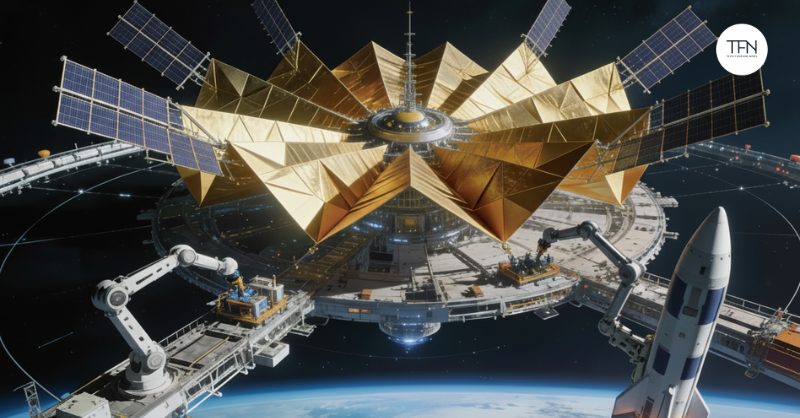
Planet A has issued a bold thesis: the most underpriced infrastructure opportunity of this century is not on Earth—it is in space. In a recent statement highlighted by TFN, the firm argues that the combination of falling launch costs, rising demand for satellite-enabled services, and the emergence of in-orbit operations is setting up a long-duration investment cycle that resembles earlier waves of terrestrial infrastructure buildouts.
The claim lands at a moment when governments and private capital are both recalibrating their priorities. From climate monitoring and disaster response to secure communications and navigation, space-based systems are increasingly treated as critical infrastructure rather than optional technology. Planet A contends that markets are still pricing many parts of the sector as speculative “space tech,” even as the underlying economics begin to look more like utilities, logistics networks, and industrial services.
Why Planet A believes space is still mispriced
At the heart of Planet A’s argument is a mismatch between perception and function. Space assets—particularly satellites and the ground networks that operate them—already underpin everyday services such as weather forecasting, GPS, maritime tracking, and broadband backhaul. Yet, the investment narrative often lags behind the operational reality, treating space as a frontier rather than a foundational layer of modern economies.
One driver is the rapid decline in the cost of getting mass to orbit. Reusable rockets, more frequent launches, and manufacturing advances have turned access to orbit into a scalable service. As launch becomes more routine, the bottleneck shifts to what happens next: building reliable, maintainable, and interoperable systems in orbit and on the ground. That shift, Planet A suggests, is where infrastructure-style value can accrue.
From one-off missions to repeatable services
Historically, many space projects were bespoke: unique spacecraft, long timelines, and limited supply chains. The new model emphasizes repeatability—constellations of satellites, standardized components, and continuous replenishment. This industrialization is crucial because it enables predictable unit economics, a prerequisite for infrastructure investors and long-term operators.
The space infrastructure stack: what counts as “infrastructure” now
Planet A frames space infrastructure as a stack rather than a single category. It includes orbital assets, terrestrial support systems, and a growing layer of in-orbit services that could make space operations more resilient and cost-effective.
- Launch services: The logistics gateway that determines cost, cadence, and reliability for everything else.
- Satellite constellations: Communications, Earth observation, and navigation networks that behave increasingly like distributed utilities.
- Ground stations and terminals: Antennas, user hardware, and network management systems that connect orbital capacity to customers.
- In-orbit servicing: Refueling, repairs, repositioning, and life-extension services that could reduce replacement costs and space debris.
- Space domain awareness: Tracking and collision-avoidance capabilities that support safety and insurance-grade risk management.
Seen through this lens, the opportunity is less about a single breakthrough and more about building the connective tissue that allows space-based capabilities to scale predictably—much like ports, rail, fiber, and power grids did in earlier eras.
Demand signals: why the market is pulling space forward
Several demand-side forces are converging. First is the expansion of data needs. Earth observation satellites can provide frequent, high-resolution monitoring of crops, forests, emissions, supply chains, and critical infrastructure. This supports both commercial applications and public policy, especially as climate risks intensify.
Second is geopolitical and security pressure. Secure communications and resilient positioning, navigation, and timing are increasingly viewed as strategic necessities. That reframes certain space systems as national infrastructure, which can unlock long-term procurement and public-private partnerships.
Third is the connectivity gap. Satellite broadband and backhaul are positioned to serve remote regions, maritime routes, aviation, and emergency response—areas where terrestrial fiber is expensive or slow to deploy. As more industries digitize, the value of ubiquitous connectivity rises, strengthening the business case for orbital networks.
Capital markets and the “infrastructure” re-rating question
Planet A’s “underpriced” claim implies a potential re-rating: parts of the sector may eventually be valued less like venture-style moonshots and more like cash-flowing infrastructure. That transition, however, depends on execution and risk containment.
Investors will likely scrutinize contract structures, customer concentration, and the durability of demand. Space businesses that can demonstrate recurring revenue, high utilization rates, and long-term service agreements may attract a broader pool of capital, including infrastructure funds and institutional allocators that typically avoid early-stage technology risk.
Key risks that could challenge the thesis
- Regulatory uncertainty: Spectrum allocation, licensing, and debris mitigation rules can reshape economics.
- Congestion and debris: More objects in orbit increase collision risk and insurance complexity.
- Technology cycles: Rapid improvements can shorten asset lifetimes and pressure margins.
- Geopolitical constraints: Export controls and national security policies can fragment markets.
Even so, infrastructure buildouts have historically been messy before they became indispensable. The question is whether space is now crossing the threshold where reliability, redundancy, and service continuity matter as much as innovation.
What to watch next
If Planet A is right, the next phase of the space economy will be defined by operational maturity: more standardized procurement, clearer safety frameworks, deeper supply chains, and business models that reward uptime rather than novelty. Watch for growth in in-orbit servicing pilots, expanded ground network capacity, and multi-year contracts for Earth observation and secure communications.
For policymakers, the implications are equally significant. Treating space as infrastructure invites questions about resilience, interoperability, and public oversight—similar to how governments manage ports, telecom networks, and energy systems. For markets, it sets up a debate over valuation: whether space companies should be assessed primarily on futuristic narratives or on the tangible, compounding value of infrastructure that the modern economy increasingly cannot function without.
Dailyza will continue tracking how investors, regulators, and operators respond as space shifts from a high-risk frontier to a practical layer of global infrastructure.