

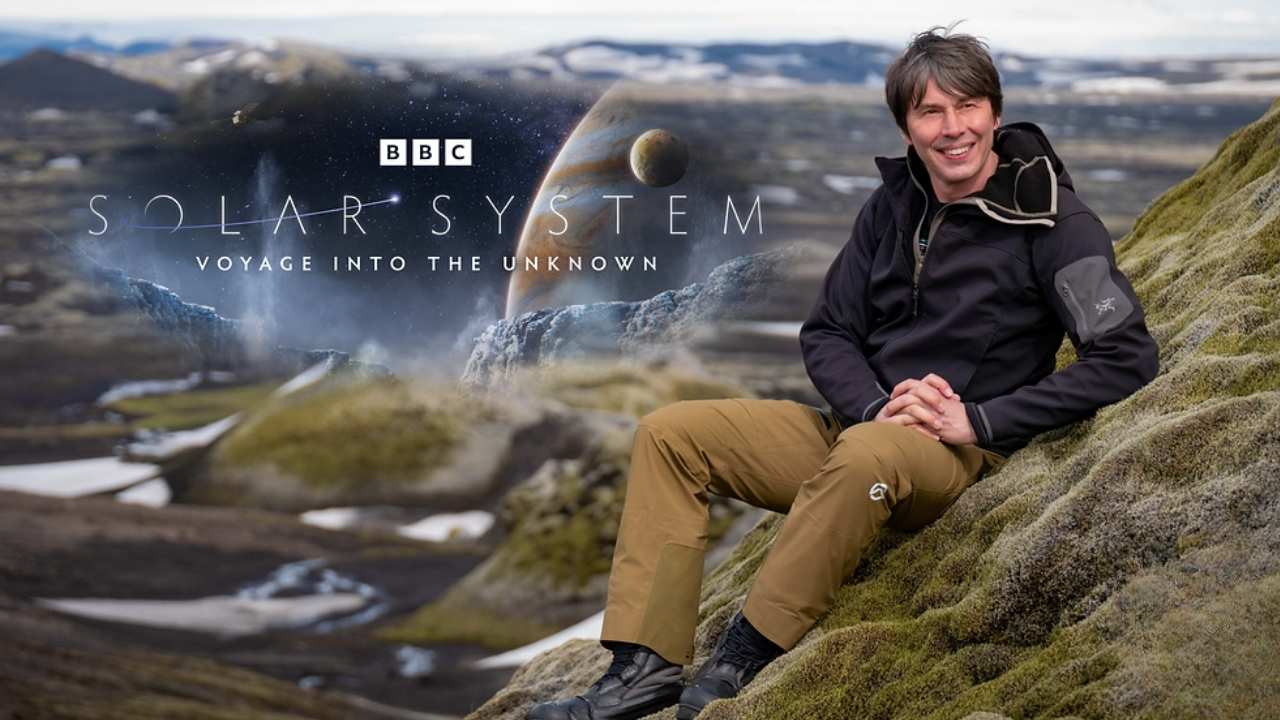
BBC has unveiled a new space documentary series, Solar System (2024, TV-G), fronted by Professor Brian Cox, promising a cinematic tour of the Sun’s neighborhood packed with headline-grabbing planetary phenomena—from “diamond rain” to “supersized volcanoes” and even “exploding oceans.”
The series arrives at a moment of renewed public fascination with planetary science, fueled by a steady stream of mission data and new research into the atmospheres, geology, and volatile weather of worlds beyond Earth. Solar System positions itself as a guided expedition through those developments, framing the latest discoveries as a set of mysteries and natural wonders spread across the diverse bodies orbiting the Sun.
What the BBC’s ‘Solar System’ is promising
In its description, BBC invites audiences to take a “front row seat” as the series moves across “ice giants, dark worlds, volcanic landscapes and bizarre, unexplainable celestial bodies.” The show’s hook is scale and variety: each planetary environment is treated as its own extreme ecosystem with distinct physics, chemistry, and history.
While the promotional language leans into spectacle, the scientific appeal is straightforward: the Solar System is an archive of experiments in planetary formation and evolution. Comparing worlds—rocky planets, gas giants, icy moons, and small bodies—helps scientists test theories about how atmospheres form, why volcanism persists on some objects, and how water and other volatiles migrate over billions of years.
From diamond rain to giant dust devils
The series highlights phenomena that have become shorthand for the weirdness of other planets. “Diamond rain” is commonly associated with models of carbon-rich chemistry deep inside ice giants, where extreme pressure could force carbon into crystalline forms. “Giant dust devils” evoke the outsized atmospheric vortices observed on Mars, where thin air and temperature gradients can still whip up towering columns of dust.
“Exploding oceans” and “supersized volcanoes” point to the violent interplay of heat and volatiles across the Solar System—whether through cryovolcanism on icy moons, magma-driven eruptions on rocky worlds, or catastrophic resurfacing events. The series appears to frame these as narrative set pieces, using them to explain how energy moves through planetary systems.
Who is behind the series
Professor Brian Cox serves as host, continuing his long-running role as an on-screen interpreter of astronomy and physics for mainstream audiences. The listed directors are Amena Hasan and Ben Wilson, with BBC Studios Productions named as the series production company under the British Broadcasting Corporation umbrella.
That production pedigree matters in the natural history and science documentary space, where viewers increasingly expect not just explanation but also high-end visualization. Modern space series rely on a mix of mission imagery, telescope data, laboratory results, and sophisticated CGI to reconstruct environments that cannot be filmed directly.
Why this series lands now
Planetary science has entered a particularly rich era. Recent years have brought new maps of planetary surfaces, fresh insights into atmospheric loss and circulation, and more detailed understanding of moons that may harbor subsurface oceans. Even when a series does not center on a single mission, it benefits from the broader momentum: each new dataset refines the story of how worlds form, break, and sometimes renew themselves.
Solar System also fits a broader media trend: audiences want science content that is both accurate and emotionally legible—stories that translate remote measurements into concrete experiences. A volcano becomes a way to talk about internal heat; a dust devil becomes a lesson in fluid dynamics; an “ice giant” becomes a case study in chemistry under pressure.
Regional availability: ‘Not available in your region’
One immediate point of friction for some viewers is access. The page associated with Solar System includes a notice stating: “Unfortunately, this content is not available in your region,” directing users to a FAQ page. This kind of message is familiar to international audiences navigating the patchwork of content licensing, distribution rights, and platform-specific availability.
In practice, availability can depend on where a viewer lives and which service carries the series locally—whether through a broadcaster, a streaming partner, or a regional version of a platform. For globally recognized brands like BBC, the audience expectation is often “worldwide,” but contractual realities frequently produce staggered releases or territory restrictions.
What viewers can do next
When a title is geo-restricted, the most reliable next steps are to check official BBC help resources and local listings, since release windows may shift by market. In many regions, BBC programming is distributed via partner services or dedicated international platforms, and availability can change after an initial launch period.
What to watch for as ‘Solar System’ rolls out
For science-minded viewers, the most telling measure of the series will be how it balances wonder with precision. The Solar System is full of extremes, but the “why” is often more compelling than the “wow”: what observations support a claim, what remains uncertain, and how scientists test competing explanations.
If Solar System delivers on its promise, it will offer more than a highlight reel of alien weather and spectacular geology. It will use those moments to show how planetary scientists infer conditions from sparse signals—turning faint spectra, gravity measurements, and surface imagery into a coherent portrait of worlds that are, in many cases, still only partly understood.
For now, BBC is betting that the combination of Professor Brian Cox, cutting-edge visualization, and a Solar System full of genuine mysteries will keep audiences looking outward—while many also keep checking whether the series has arrived in their region yet.