

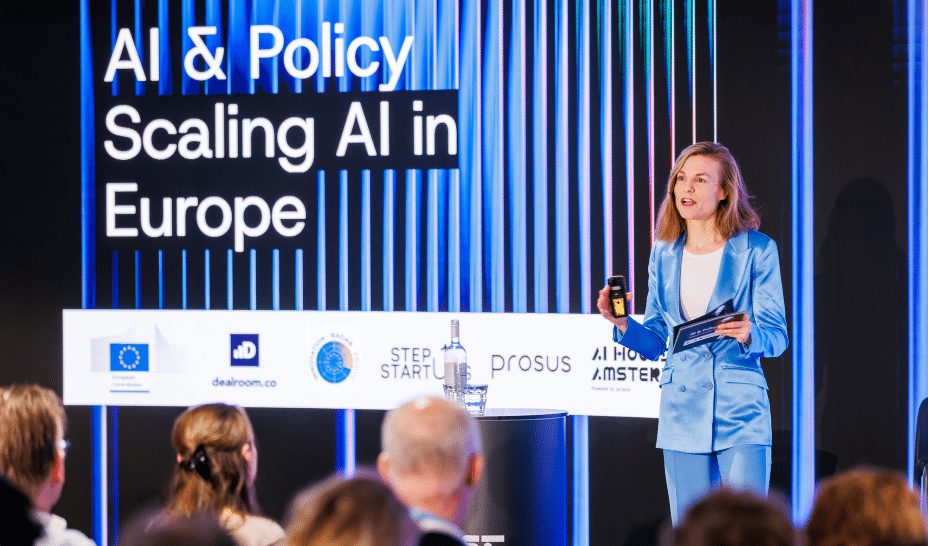
EU-Startups took part on 11 December 2025 in the European Commission’s AI Policy Day, a full-day, high-level event focused on one central question: how to scale artificial intelligence across Europe in a way that strengthens competitiveness while maintaining trust, safety, and legal clarity.
The gathering brought together policymakers, industry voices, and ecosystem builders to align on practical pathways for European AI adoption—particularly for startups and scaleups that must navigate fragmented markets, uneven access to computing power, and fast-evolving rules. For the Commission, the day served as both a signal and a working session: Europe wants more AI deployed in real businesses, not just discussed in strategy papers.
Why the European Commission is pushing “scaling” now
Europe’s AI debate has shifted from whether to regulate to how to build. With major global players investing heavily in foundation models, cloud infrastructure, and AI talent, European institutions are under pressure to ensure the region does not become primarily a consumer of AI technologies developed elsewhere.
“Scaling” in this context refers to the ability for European companies to move from pilots to production—deploying AI in sectors such as manufacturing, healthcare, mobility, energy, and public services—while competing globally. It also implies building the enabling conditions: reliable access to compute, high-quality data, cross-border market reach, and predictable compliance pathways.
What AI Policy Day signals for startups and scaleups
For startup ecosystems, participation by EU-Startups underscores a growing recognition that policy discussions are no longer abstract. The rules and support mechanisms being shaped now will influence how quickly European founders can build, test, and commercialize AI products—especially those that may fall into higher-risk categories.
Regulation meets execution
The European Union’s approach to AI has emphasized trust and accountability, but founders often ask for clearer operational guidance: how to document models, manage data governance, conduct risk assessments, and communicate system limitations to customers. Events like AI Policy Day provide a venue for ecosystem stakeholders to push for practical, scalable compliance—particularly important for early-stage teams without large legal departments.
Compute and infrastructure as competitiveness issues
Scaling AI is not only a software challenge. Training and running modern models requires significant compute resources, specialized chips, and robust cloud capacity. For many European startups, accessing affordable compute at the right performance level can be a bottleneck. The Commission’s focus on scaling suggests continued attention to infrastructure pathways—whether through public-private initiatives, procurement programs, or partnerships that expand access to high-performance resources.
The policy themes likely at the center of the discussion
While the event summary emphasizes the broad aim of scaling AI in Europe, the policy agenda around that goal typically clusters around a few recurring themes that matter to companies building and deploying AI.
Single market momentum for AI products
Startups frequently cite Europe’s fragmented go-to-market reality as a growth constraint: different procurement practices, language and compliance needs, and varying sector rules across member states. A policy focus on scaling implies efforts to reduce friction so AI products can expand faster across borders—especially in regulated sectors where adoption cycles are already long.
Trust, safety, and liability expectations
European policymakers have been explicit that trust is a competitive advantage. For companies, that translates into building robust evaluation practices, transparency measures, and monitoring mechanisms for deployed systems. As AI becomes embedded in critical workflows, questions of accountability and liability become more operational than philosophical—affecting contracts, insurance, customer due diligence, and product roadmaps.
Talent and skills development
Scaling also depends on people: researchers, engineers, product leaders, and domain specialists who can integrate AI into real-world processes. Europe’s talent pool is strong, but competition is global. Policy discussions increasingly intersect with education, reskilling, and immigration frameworks that influence whether companies can hire fast enough to meet demand.
Why ecosystem voices like EU-Startups matter in these rooms
High-level policy events can risk becoming detached from startup reality unless ecosystem representatives bring concrete examples: how long procurement takes for an AI startup selling to the public sector, what compliance documentation costs at seed stage, or how a fast-growing company struggles to secure stable compute contracts.
EU-Startups has positioned itself as a connector across founders, investors, and innovation communities, and participation in the Commission’s AI Policy Day aligns with a broader trend: policy is becoming a core part of the European startup playbook. For founders, the ability to anticipate regulatory expectations early can reduce later friction with enterprise buyers and public-sector customers who increasingly demand strong governance.
What to watch next after AI Policy Day
For European AI builders and adopters, the most important outcomes will be visible in follow-through: clearer guidance, better resourcing for enforcement and support, and programs that translate political ambition into deployable infrastructure and accessible funding.
- Implementation guidance that helps startups understand obligations without excessive legal overhead.
- Compute access initiatives that reduce the cost barrier for training and running models in Europe.
- Public procurement pathways designed to help innovative AI companies sell into government and regulated sectors.
- Cross-border harmonization that makes scaling across the EU more predictable for product teams and investors.
As Europe moves from AI strategy to AI rollout, the Commission’s emphasis on scaling—and the presence of ecosystem stakeholders such as EU-Startups—highlights a pragmatic shift: the next phase will be judged less by announcements and more by whether European companies can build, deploy, and grow AI products at global speed while meeting European expectations for trust and accountability.