

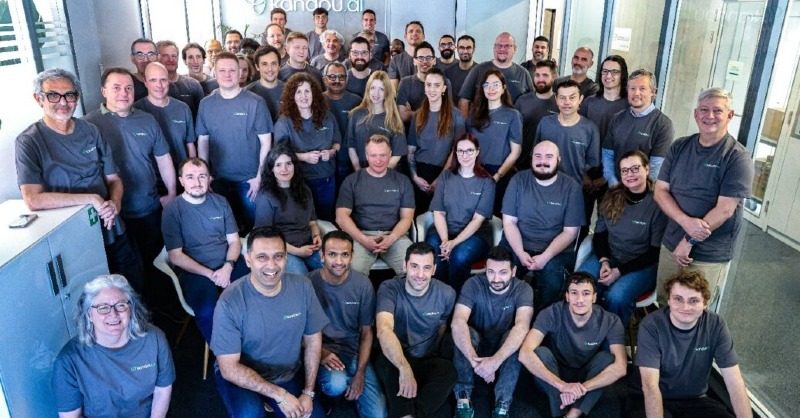
Kandou AI Raises $225 Million to Ease Data Bottlenecks in AI
Kandou AI, a semiconductor and AI infrastructure company, has secured a substantial $225 million funding round backed by investors including Maverick Silicon and SoftBank. The capital will be used to address one of the most pressing constraints in modern computing: the data movement bottleneck that limits the performance and efficiency of large-scale AI models.
Targeting the AI Data Movement Crisis
As cloud providers and enterprises deploy ever-larger generative AI and machine learning workloads, the cost and latency of moving data between chips and memory increasingly outweigh raw compute power. Kandou AI focuses on advanced interconnect and high‑bandwidth chip technologies designed to move data faster, with lower power consumption and reduced infrastructure cost.
Industry analysts note that data transfer across servers and within data centers now represents a major barrier to scaling AI inference and AI training. By optimizing how data flows between accelerators, CPUs and memory, Kandou AI aims to unlock higher utilization of existing compute resources and cut the total cost of ownership for large AI clusters.
Strategic Backing from Maverick Silicon and SoftBank
The participation of Maverick Silicon and SoftBank signals strong confidence in the long‑term demand for specialized AI infrastructure. Both investors have a track record of backing deep‑tech companies that sit at the foundation of the digital economy, from connectivity to cloud computing.
According to people familiar with the deal, the fresh capital will accelerate product development, expand partnerships with cloud and hyperscale data center operators, and support pilot deployments with leading AI platform providers. The company is expected to invest heavily in R&D to refine its interconnect standards and silicon implementations.
Implications for the AI Hardware Ecosystem
The race to remove data bottlenecks is reshaping the broader semiconductor and data center landscape. While GPU and accelerator vendors focus on compute density, companies like Kandou AI are carving out a critical niche in the underlying fabric that ties AI systems together.
If its technology delivers on promised gains in bandwidth, latency and energy efficiency, Kandou AI could become a key enabler for next‑generation AI clusters, allowing cloud providers to scale services more sustainably and at lower cost. For investors such as Maverick Silicon and SoftBank, the bet is that solving data movement challenges will be as valuable as building the next flagship AI chip.