

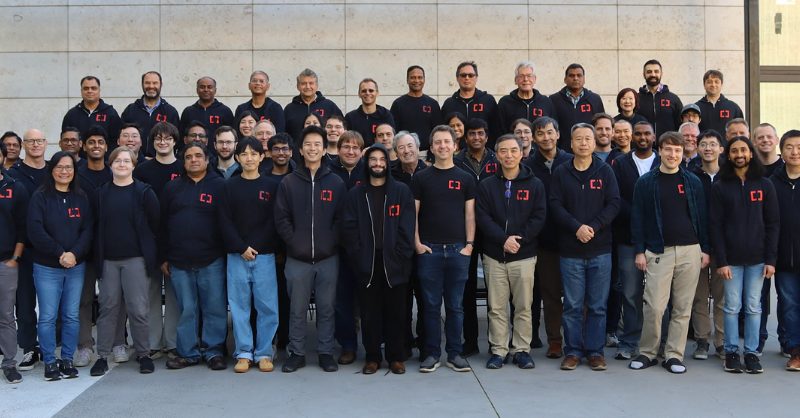
Ex-Google chip team targets Nvidia with $500M AI silicon war chest
A group of former Google chip architects has raised roughly $500 million to develop custom silicon designed specifically for running large language models (LLMs), setting up a direct challenge to Nvidia‘s dominance in data center AI accelerators.
The still-stealth venture, founded by engineers who worked on Google TPU and other in-house accelerators, is positioning its hardware as a purpose-built alternative to general-purpose GPUs. By focusing narrowly on LLM inference and training workloads, the company aims to deliver higher performance per watt and lower total cost of ownership for cloud providers and AI-native enterprises.
Why LLM-specific silicon matters
As demand for generative AI surges, the market for high-end AI chips has become constrained and expensive, with Nvidia’s H100 and upcoming B100 accelerators in short supply. This has driven cloud platforms, hyperscalers and startups to explore custom ASIC designs optimized for transformer-based models.
The ex-Google team is betting that LLM-focused silicon can outperform GPUs on metrics that matter most to operators: latency, throughput and energy efficiency. Their architecture is expected to emphasize high-bandwidth on-chip memory, fast interconnects for model parallelism and hardware-level support for quantization and sparsity techniques common in modern LLM stacks.
Strategic implications for the AI hardware race
The $500 million capital raise signals that investors believe Nvidia’s grip on the AI infrastructure market is vulnerable at the margins, particularly for customers willing to optimize their software around a new hardware platform. If successful, the startup could help diversify supply in an ecosystem heavily dependent on a single vendor.
Industry observers note that winning share from Nvidia will require more than raw performance. The new company must build a robust software stack, including compilers, libraries and integrations with popular AI frameworks such as PyTorch and JAX, while convincing developers that the migration cost is justified by long-term savings.
For now, the funding gives the ex-Google founders enough runway to tape out multiple chip generations and court early design partners among cloud providers and large AI labs. Their progress will be closely watched as competition intensifies across the AI hardware landscape.