

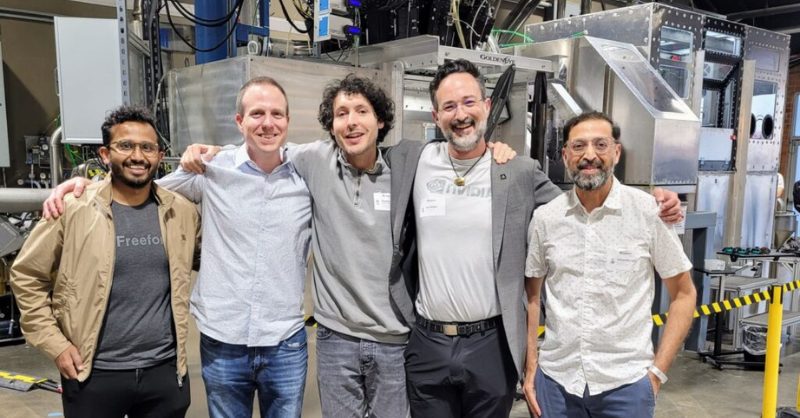
Founders Fund bets on Freeform’s ultra-fast Skyfall platform
Venture firm Founders Fund has backed Freeform, a manufacturing startup developing what it claims is the fastest laser melting platform yet for industrial-scale metal 3D printing. The flagship system, called Skyfall, is designed to move metal additive manufacturing from prototyping into true high-volume production.
What makes Skyfall different
Skyfall is built around advanced laser powder bed fusion technology, but with a strong focus on throughput, automation and reliability. The platform combines multiple high‑power lasers, real‑time computer vision and proprietary AI algorithms to monitor each layer of a part as it is being produced.
By tightly integrating software, robotics and quality control, Freeform aims to eliminate many of the bottlenecks that have historically kept metal 3D printing from competing with conventional manufacturing. Automated powder handling, part removal and inspection are intended to keep machines running continuously with minimal human intervention.
Industrial applications in focus
The investment underscores growing interest in using additive manufacturing for end‑use parts in sectors such as aerospace, defence, automotive and medical devices. These industries increasingly demand complex, lightweight geometries that are difficult or impossible to achieve with traditional casting or machining.
According to the company, Skyfall is engineered for repeatability and certification‑grade traceability, two key requirements for regulated markets. The platform’s data‑rich architecture records process parameters for every build, enabling detailed analysis and faster qualification of new parts.
Strategic signal for the additive market
The backing from Founders Fund, known for early investments in transformative deep tech, signals confidence that high‑speed metal additive systems are approaching an inflection point. As manufacturers seek more resilient and flexible supply chains, scalable 3D printing platforms like Skyfall are being positioned as a way to localise production and reduce dependence on complex global logistics.
If Freeform can deliver on its performance claims, the company could help push metal additive manufacturing from a niche capability into a mainstream production technology for mission‑critical components.