

Ethernovia Raises $90M to Advance Real-Time AI Networking
Ethernovia, a specialist in high-performance Ethernet networking silicon, has secured a $90 million Series B funding round to accelerate the development of chips designed to power real-time AI in autonomous vehicles and robots. The round is led by Maverick Silicon, with strategic participation from automotive investor Porsche SE and semiconductor giant Qualcomm, underscoring the growing race to equip next-generation mobility platforms with faster, more reliable data networks.
Strategic Backing from Automotive and Chip Leaders
The presence of Porsche SE and Qualcomm in the Series B syndicate highlights the strategic importance of in-vehicle networking as the automotive industry shifts toward autonomous driving and software-defined architectures. While financial terms from individual investors were not disclosed, the combined support signals strong conviction in Ethernovia‘s approach to rethinking how data moves inside cars and robotic platforms.
For established players like Qualcomm, which already supplies automotive SoCs and connectivity solutions to global carmakers, the investment offers a pathway to tighter integration between compute platforms and the Ethernet backbone that feeds them. For Porsche SE, the holding company with core stakes in the Volkswagen Group, the move aligns with a broader industry trend of investing in critical enabling technologies for electric and autonomous vehicles.
Why Ethernet Is Becoming the Nervous System of Smart Vehicles
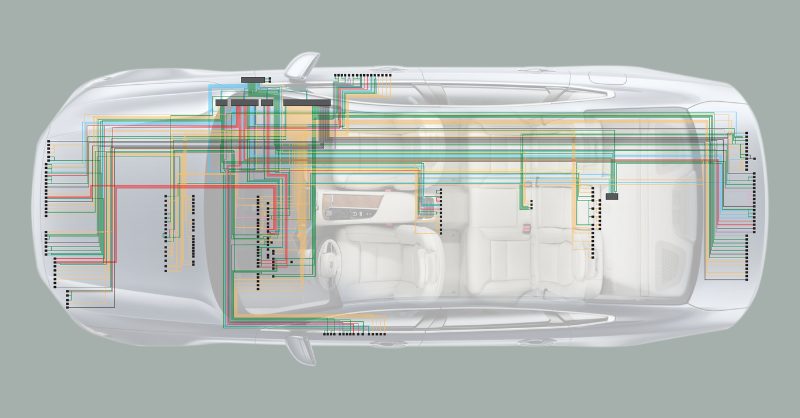
Modern vehicles are rapidly evolving into high-performance computers on wheels, packed with sensors, cameras, radar, lidar and powerful AI processors. Each of these components generates massive volumes of data that must be transmitted, processed and acted on in milliseconds. Traditional in-vehicle networking technologies such as CAN bus and LIN were never designed for this scale or speed.
Automotive Ethernet has emerged as the preferred standard for high-bandwidth, deterministic communication inside vehicles. It enables gigabit-level throughput and supports time-sensitive networking (TSN), which is crucial for real-time AI decision-making in functions such as lane keeping, collision avoidance and automated parking.
Ethernovia is positioning its chips as the core fabric connecting domain controllers, sensor clusters and central compute units in next-generation architectures. By providing low-latency, secure and power-efficient switching and routing, the company aims to become the de facto backbone for software-defined vehicles and advanced robotic systems.
Enabling Real-Time AI in Autonomous Vehicles and Robots
The new funding will help Ethernovia accelerate development and commercialization of its Ethernet networking chips, which are tailored for real-time AI workloads. In both autonomous vehicles and industrial robots, the ability to move data quickly and predictably is as important as the raw performance of the AI algorithms themselves.
Data Deluge in Autonomous Systems
Self-driving and highly automated vehicles can generate terabytes of data per day from a combination of cameras, lidar, radar and ultrasonic sensors. This information must be aggregated, filtered and processed by centralized or zonal compute units that run perception, sensor fusion and path-planning models. Any delay or jitter in data delivery can degrade the performance of safety-critical functions.
Ethernovia‘s chips are designed to support deterministic latency, enabling real-time AI pipelines where sensor data reaches compute nodes within tightly controlled time windows. This capability is essential for meeting stringent functional safety and reliability requirements in automotive applications.
Robotics and Industry 4.0 Applications
Beyond cars, the same networking challenges are emerging in collaborative robots, automated warehouses and smart factories. These systems depend on edge AI to coordinate motion, avoid collisions and respond dynamically to changing environments. Here again, high-bandwidth, real-time networking is a prerequisite for safe and efficient operation.
By targeting both autonomous vehicles and robotics, Ethernovia is tapping into two of the fastest-growing segments of the AI hardware and embedded systems markets. The fresh capital will allow the company to expand engineering teams, scale manufacturing partnerships and deepen collaboration with automotive OEMs, tier-one suppliers and robotics integrators.
Positioning in the Competitive Automotive Networking Landscape
The market for automotive Ethernet and advanced networking silicon is increasingly competitive, with established semiconductor vendors and specialized startups vying for design wins in future vehicle platforms. Key differentiators include bandwidth, power efficiency, functional safety certification, support for TSN standards and integration with existing vehicle software stacks.
With backing from Maverick Silicon, Porsche SE and Qualcomm, Ethernovia gains not only capital but also access to deep domain expertise in chip design, automotive engineering and global supply chains. This combination strengthens its ability to compete for long-term platform commitments from major carmakers and industrial automation providers.
Outlook: Networking as a Foundation for Software-Defined Mobility
As vehicles transition from hardware-centric products to software-defined platforms, the role of in-vehicle networking is shifting from a supporting utility to a strategic foundation. Over-the-air updates, subscription-based features, advanced driver assistance and fully autonomous driving all depend on robust data infrastructure inside the vehicle.
The $90 million Series B round gives Ethernovia additional runway to refine its technology roadmap and prove its solutions in large-scale deployments. With the endorsement of leading players from both the automotive and semiconductor ecosystems, the company is positioning itself at the heart of how real-time AI will be delivered in the next generation of cars and robots.
For automakers, suppliers and industrial operators, the message is clear: the battle for leadership in autonomous mobility and intelligent robotics will be fought not only in AI compute, but also in the networking fabric that keeps every sensor, controller and processor in constant, real-time conversation.