

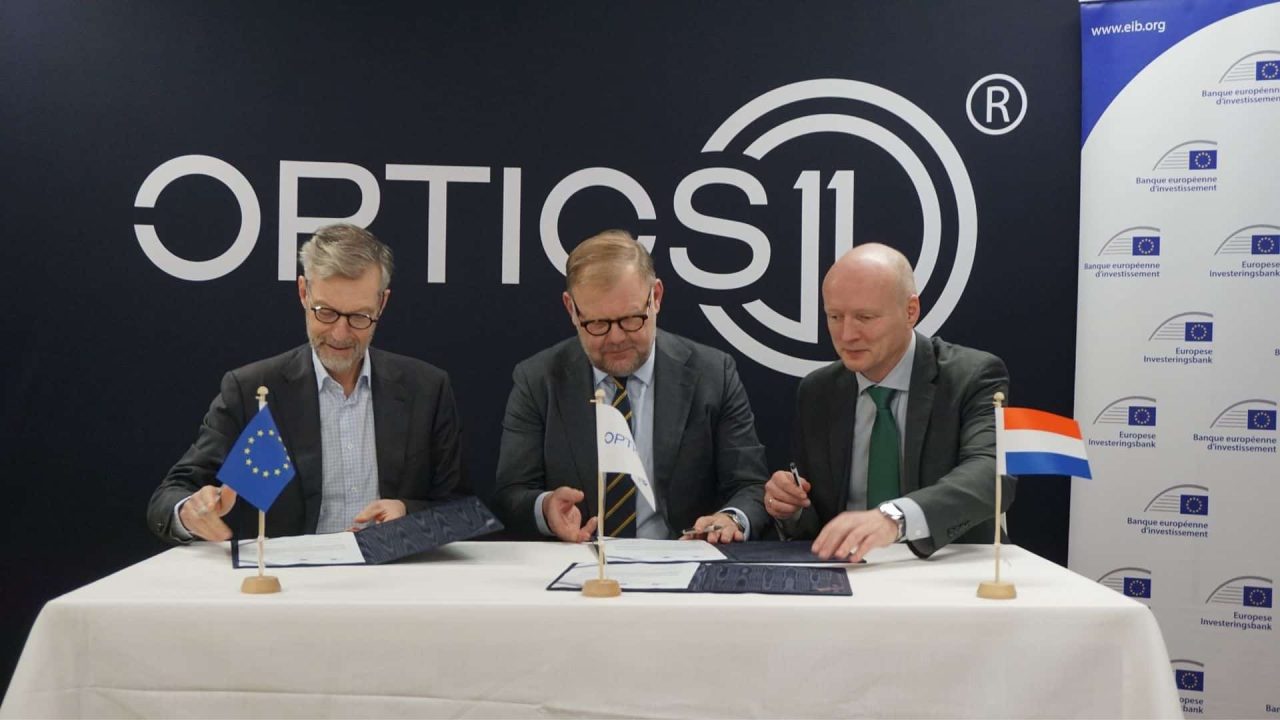
Optics11 wins €25 million backing from European Investment Bank
Amsterdam-based DeepTech scale-up Optics11 has secured a €25 million venture debt facility from the European Investment Bank (EIB), strengthening its position in the rapidly growing field of advanced fiber-optic sensing. The financing agreement underscores Europe’s strategic push to support industrial innovation, high-precision measurement technologies and resilient manufacturing infrastructure.
Who is Optics11 and why it matters
Founded in Amsterdam, Optics11 specializes in high-performance fiber-optic sensing systems used for monitoring critical assets and processes across sectors such as energy, infrastructure, aerospace, and advanced manufacturing. The company’s solutions leverage optical interferometry and micro-electro-mechanical systems (MEMS) to deliver extremely sensitive measurements of vibration, strain, pressure and acoustic signals in harsh environments where traditional electronic sensors fail.
By combining proprietary photonics hardware with advanced signal processing and data analytics, Optics11 provides industrial customers with real-time insights that can prevent failures, reduce downtime and extend the lifespan of critical assets. This capability is increasingly vital as Europe modernizes its infrastructure and energy systems under ambitious decarbonisation and digitalisation agendas.
Details of the EIB venture debt agreement
The newly signed agreement gives Optics11 access to up to €25 million in venture debt, a form of growth financing designed to support innovative, high-potential companies that are scaling quickly but may not yet fit traditional bank lending criteria. Unlike standard loans, venture debt typically offers more flexible repayment terms and is tailored to the risk profile of DeepTech businesses investing heavily in research and development (R&D).
The facility is expected to be disbursed in tranches, linked to agreed milestones in product development, commercial rollout and international expansion. The backing from the EIB not only injects capital but also serves as a strong validation of the company’s technology, market potential and governance standards.
Strategic use of funds: R&D, industrialisation and global reach
Accelerating DeepTech product roadmap
A significant share of the funding will be directed toward expanding Optics11’s R&D capabilities. The company aims to refine its next generation of fiber-optic sensing platforms, increasing sensitivity, reducing footprint and improving integration with existing industrial systems. Further investment in AI algorithms and machine-learning-based analytics is also expected, enabling automated detection of anomalies and predictive maintenance recommendations for customers.
Scaling manufacturing and industrial deployment
To meet growing demand from utilities, infrastructure operators and high-tech manufacturers, Optics11 plans to strengthen its production capabilities and supply chain. That includes scaling up manufacturing of proprietary optical components, improving calibration and testing facilities, and implementing robust quality assurance frameworks that meet stringent industrial and aerospace standards.
By industrialising its technology at scale, the company seeks to transition from niche deployments to large, fleet-wide monitoring solutions that can cover pipelines, wind farms, bridges, tunnels and advanced production lines.
Expanding international footprint
The venture debt facility will also support Optics11’s geographic expansion, particularly in North America and Asia-Pacific, where demand for high-reliability sensing systems is rising. The company is expected to invest in local sales, engineering support and partnerships with system integrators, allowing its technology to be embedded into major infrastructure and energy projects worldwide.
Why the EIB is betting on DeepTech sensing
The European Investment Bank, often described as the lending arm of the European Union, has intensified its support for DeepTech in recent years. Backing companies like Optics11 aligns with EU priorities in industrial competitiveness, strategic autonomy and climate resilience. Advanced sensing technologies are viewed as critical enablers of safer, more efficient and low-carbon infrastructure.
High-resolution monitoring systems can, for example, detect micro-cracks in bridges before they become structural threats, identify early-stage faults in offshore wind turbines or pinpoint irregularities in high-pressure pipelines. By enabling predictive maintenance and data-driven asset management, such technologies help operators reduce emissions, cut operational costs and avoid catastrophic failures.
Positioning within Europe’s DeepTech ecosystem
Optics11 sits at the intersection of several strategic European technology domains: photonics, advanced manufacturing, industrial IoT and data analytics. The company’s progress reflects a broader trend in Europe, where a new generation of DeepTech scale-ups is moving from the lab to the factory floor, converting academic breakthroughs into commercially viable products.
The support from the EIB is likely to attract additional interest from venture capital and strategic investors, who increasingly view industrial sensing and monitoring as core to the future of energy, transport and critical infrastructure. As regulatory pressure mounts on operators to document safety, reliability and environmental performance, demand for robust, high-fidelity measurement systems is expected to grow sharply.
Outlook: From niche innovation to industrial standard
With the €25 million venture debt agreement in place, Optics11 is positioned to accelerate its evolution from a high-tech niche player into a mainstream industrial partner. The company’s combination of cutting-edge fiber-optic sensing, integrated software analytics and field-proven hardware gives it a strong platform to capture a share of the global market for structural health monitoring and asset integrity.
As Europe channels more capital into DeepTech scale-ups and critical technologies, the partnership between Optics11 and the European Investment Bank stands as a clear example of how public-backed financing can help translate complex engineering innovation into tangible economic and societal value.