

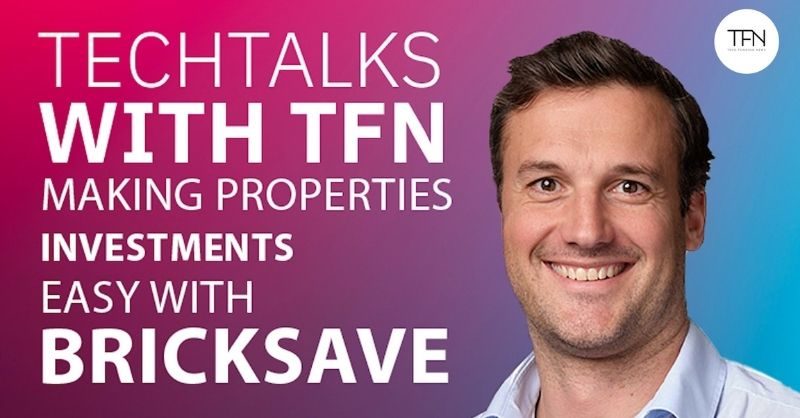
Tom de Lucy’s mission to fix a broken property market
The global property market has long been dominated by banks, institutional funds and high‑net‑worth investors, leaving ordinary savers locked out by high entry costs, opaque fees and complex legal structures. Tom de Lucy, co‑founder and CEO of Bricksave, believes that model is not just outdated but fundamentally unfair — and he is betting on tokenised real estate to change it.
In a recent TechTalks interview, de Lucy outlined how Bricksave is using blockchain, digital tokens and a streamlined online experience to make global property investment accessible with just a few hundred dollars, rather than the six‑figure sums typically required.
Turning buildings into tokens
At the core of Bricksave is a simple but powerful idea: break real‑world properties into small, tradeable digital units.
How tokenisation works on Bricksave
Instead of buying an entire apartment or commercial unit, investors purchase security tokens that represent fractional ownership in a specific, income‑generating property. Each token entitles the holder to a share of the rent and, ultimately, a share of any capital appreciation when the asset is sold.
Behind the scenes, Bricksave structures each property within a regulated legal entity, then issues asset‑backed tokens on a blockchain network. The blockchain acts as a transparent, tamper‑resistant ledger, recording who owns what in real time.
For users, the experience is closer to a modern fintech app than to a traditional real estate transaction. They can browse properties around the world, review projected yields, invest from their phone and track rental income and portfolio performance through a dashboard.
Lowering the entry barrier
One of the most significant shifts is the minimum ticket size. Where direct property investment often requires tens or hundreds of thousands of dollars, Bricksave allows participation from a few hundred dollars per property. That opens the door for:
- First‑time investors looking to diversify beyond savings accounts and equities
- Residents in emerging markets who want exposure to more stable real estate abroad
- Experienced investors seeking fractional access to different cities and asset classes
By fractionalising ownership, de Lucy argues that real estate can finally function like a modern investment product rather than an all‑or‑nothing purchase.
Why the traditional property system is under strain
De Lucy is blunt about the shortcomings of the current market. For decades, property has been a proven store of value, but the mechanics of investing have remained stubbornly analogue.
High friction, low transparency
Buying a property typically involves:
- Lengthy legal processes and multiple intermediaries
- High transaction costs and hidden fees
- Limited access to international markets
Retail investors often end up with indirect exposure through funds or REITs, where decision‑making is distant and fee structures are complex. De Lucy contends that this model leaves smaller investors bearing risk without meaningful control.
The inequality problem
Rising prices in major cities have turned property into a driver of inequality. Those who already own assets benefit from capital gains, while those without a foothold struggle to catch up. By making it possible to own fractions of professionally managed properties, Bricksave positions itself as a tool for narrowing that gap.
“Our aim is to let someone with a few hundred dollars build a globally diversified real estate portfolio,” de Lucy has said in previous conversations, framing the platform as a way to democratise an asset class historically reserved for the wealthy.
Technology, compliance and trust
While the concept of tokenised assets is not entirely new, execution and regulatory compliance separate viable platforms from speculative experiments. De Lucy is keen to emphasise that Bricksave is built as a regulated investment platform, not a crypto trading venue.
Blockchain as infrastructure, not a buzzword
The platform uses blockchain technology primarily for three reasons:
- Transparency: Ownership records and transactions are verifiable on‑chain.
- Security: Cryptographic verification reduces the risk of tampering or double‑spending.
- Efficiency: Digital settlement can cut out layers of manual reconciliation.
However, investors interact with a user‑friendly web interface rather than complex wallets or exchanges. The technical layer is largely abstracted away, which de Lucy believes is essential for mainstream adoption.
Navigating regulation
Tokenising real‑world assets places a platform squarely in the realm of securities regulation. Bricksave structures its offerings to comply with local rules in the markets where it operates, including know‑your‑customer (KYC) checks, anti‑money laundering (AML) procedures and clear disclosures on risk.
This focus on compliance is designed to distinguish the company from earlier waves of loosely regulated crypto projects, and to appeal to investors who may be sceptical of digital assets but comfortable with income‑producing property.
Global diversification, local expertise
Another pillar of the Bricksave strategy is curated access to properties in multiple geographies. Rather than leaving users to source assets themselves, the company’s team identifies, underwrites and manages opportunities.
From London to Latin America
The platform has focused on a mix of established and emerging markets, giving investors the ability to spread risk across:
- Stable, mature markets with predictable rental demand
- High‑growth cities where property values may appreciate faster
- Different segments, from residential units to select commercial assets
On the ground, local partners handle property management, tenant relationships and maintenance. Rental income flows back to investors proportionally to their token holdings, creating a stream of potential passive income.
Challenges on the road to mainstream adoption
Despite the promise of tokenised real estate, de Lucy acknowledges there are hurdles.
Education and perception
Many potential users still associate anything token‑based with speculative cryptocurrencies and market volatility. Part of Bricksave’s strategy is educational: explaining that its tokens are tied to tangible, income‑generating assets, not purely digital coins.
The company invests in clear documentation, investor FAQs and scenario modelling to help users understand both upside and risk — including vacancy periods, market downturns and potential currency fluctuations.
Liquidity and secondary markets
One of the attractions of tokenisation is the prospect of improved liquidity. De Lucy has pointed to the long‑term goal of enabling regulated secondary trading of tokens, so investors are not locked in for the full life of a property.
Building such markets, however, requires regulatory approval, robust infrastructure and sufficient investor demand. For now, many tokenised real estate platforms, including Bricksave, focus first on primary offerings and income distribution, while gradually laying the groundwork for more fluid trading.
Redefining access to property investment
As digital finance reshapes everything from payments to pensions, de Lucy sees property as the next major asset class to be transformed. By combining blockchain infrastructure, strict regulatory compliance and an accessible user experience, Bricksave aims to turn buildings into borderless, bite‑sized investments.
Whether tokenised real estate becomes a standard part of everyday portfolios will depend on regulation, market cycles and investor trust. But through one token at a time, Tom de Lucy is positioning his company at the forefront of a shift that could redefine who gets to benefit from the world’s most enduring asset: property.