

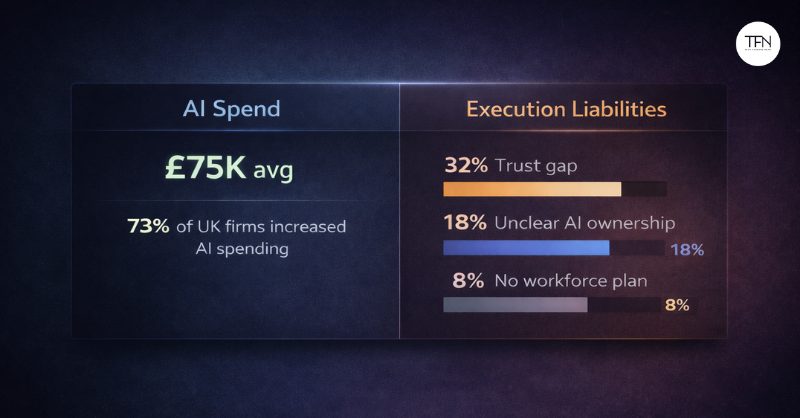
UK corporates quietly turn into serious AI buyers
UK companies spent an average of £75,000 each on AI solutions in 2025, according to new industry estimates circulating among investors and enterprise vendors. While the headline number may look modest next to multi‑million transformation programmes, it signals a decisive shift: mainstream British firms are no longer experimenting with pilots, they are budgeting for production‑grade AI deployments.
For European startup founders, this emerging spend is both an opportunity and a warning. Corporate buyers are ready to pay for AI tools that deliver measurable value, but expectations around security, integration and governance have risen just as fast.
What the £75K figure really says about AI maturity
The average outlay of £75,000 per firm covers a mix of licences, cloud consumption, integration work and training. Beneath that aggregate, the spending pattern reveals three important trends in the UK market:
From pilots to line‑item budgets
First, AI projects are becoming recurring line items in IT and operations budgets rather than one‑off experiments. Finance, retail, logistics and professional services firms are now carving out dedicated spend for:
- Generative AI assistants for employees and customer support
- Predictive analytics for demand, pricing and risk
- Automation of document workflows, compliance checks and back‑office processes
That institutionalisation of spend is what investors look for when they talk about a market “crossing the chasm”. It suggests that the UK, often a bellwether for European technology adoption, is entering an early mainstream phase.
AI now sits inside core business processes
Second, the level of spend implies that AI systems are moving closer to the core of the business. A few thousand pounds might buy a standalone tool; £75,000 typically reflects integration with existing ERP, CRM or data platforms, plus internal change management.
That has two consequences:
- Procurement cycles are getting longer and more formal, especially in regulated sectors.
- Buyers favour vendors that understand their vertical’s compliance, data and workflow constraints.
Skills and governance spend is catching up
Third, a growing slice of budgets is being allocated to AI governance, training and risk management. Boards are asking harder questions about model bias, data residency, intellectual property and the explainability of AI algorithms. UK firms are increasingly demanding:
- Clear documentation of data sources and model behaviour
- Role‑based access controls and audit trails
- Compliance with UK and impending EU AI Act requirements
This is reshaping what it takes to win enterprise deals across Europe.
Why this matters for European founders
For founders building in Berlin, Paris, Amsterdam, Barcelona or any other European hub, the UK’s 2025 AI spending profile is a forward signal. It hints at how demand may evolve across the continent over the next 12–24 months.
Opportunity: a maturing, budgeted AI market
The obvious upside is that European corporates are finally behaving like serious customers for AI startups. As UK firms normalise mid‑five‑figure annual spend, it becomes easier to justify subscription pricing that supports sustainable growth.
Founders can now credibly pitch:
- Annual or multi‑year contracts instead of short‑term pilots
- Tiered pricing aligned to usage, seats or business outcomes
- Upsell paths from departmental deployments to group‑wide rollouts
For venture capital investors, these dynamics improve visibility on revenue expansion and reduce the risk that AI products remain stuck in proof‑of‑concept limbo.
Challenge: expectations are now enterprise‑grade
The less comfortable reality is that European founders can no longer rely on novelty. Corporate buyers, especially in the UK, have already tested multiple AI platforms and are becoming more discerning. They expect:
- Robust data security and privacy controls
- Seamless integration with tools like Microsoft 365, Salesforce and major cloud providers
- Clear ROI metrics, not just productivity anecdotes
- Support, SLAs and onboarding that resemble established enterprise software vendors
For early‑stage teams, that means product and engineering roadmaps must incorporate compliance, observability and admin features earlier than in previous SaaS waves.
How founders should adapt their AI playbook
Against this backdrop, European founders targeting the UK and broader European market need to refine both product strategy and go‑to‑market execution.
1. Build for regulation, not around it
With the EU AI Act nearing implementation and the UK pursuing its own risk‑based framework, regulatory alignment is becoming a competitive advantage. Instead of treating compliance as a late‑stage hurdle, founders should:
- Design products with built‑in risk classification and documentation flows
- Offer configurable data residency options for EU and UK customers
- Provide tools for customers to audit, monitor and explain model outputs
Enterprise buyers increasingly favour vendors who can help them operationalise their own AI governance obligations.
2. Prioritise depth over breadth
The £75,000 spend level suggests that customers are willing to invest where AI solutions address specific, high‑value pain points. Generic copilots and chatbots are facing price pressure and intense competition from hyperscalers.
Founders are better served by focusing on:
- Narrow, high‑impact workflows in sectors such as legal, insurance, logistics, healthcare or industrials
- Proprietary data advantages, domain‑specific models or tightly coupled integrations
- Workflow automation that directly reduces costs or unlocks new revenue
Investors increasingly ask not “Do you use AI?” but “What can you do that a generic model cannot?”
3. Treat change management as part of the product
A significant portion of that £75,000 corporate spend is going into training, adoption and process redesign. European founders who ignore this will see stalled deployments and churn, even if their product is technically strong.
Winning vendors are starting to bundle:
- Playbooks for managers and employees on how to integrate AI tools into daily work
- Usage analytics that highlight adoption gaps and success stories
- Templates for internal policies covering acceptable use and data handling
In practice, that means product, sales and customer success teams must collaborate much more closely than in traditional software rollouts.
The new benchmark for AI‑native startups in Europe
The emerging UK benchmark of £75,000 per firm in 2025 does not just quantify spend; it defines a new baseline for what European corporates expect from AI vendors. For founders, it is a signal to professionalise faster, specialise deeper and anchor their value propositions in measurable business outcomes.
Those who can combine technical excellence with regulatory readiness, domain focus and thoughtful change management will be best placed to capture the next wave of European AI adoption—and to turn experimental budgets into durable, scalable revenue.