

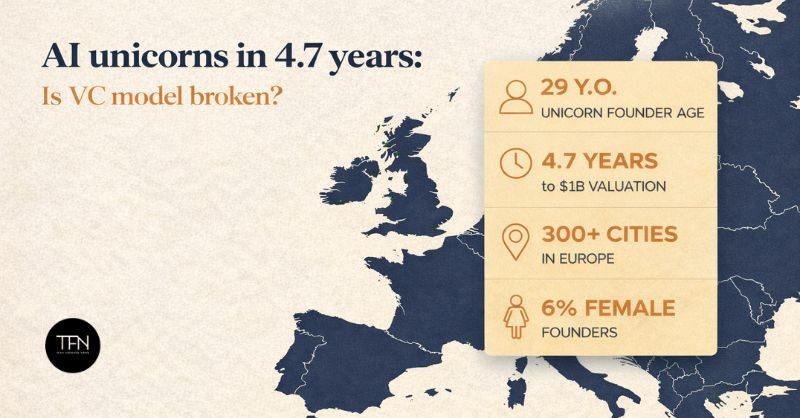
AI Unicorns in Record Time Are Testing the Venture Capital Playbook
Across global tech hubs, AI startups are hitting the coveted unicorn valuation of $1 billion in an average of just 4.7 years. For some investors, this looks like a golden age of innovation. For others, it raises a stark question: is the traditional venture capital model still fit for purpose, or is it being stretched to breaking point by the speed and scale of the current AI boom?
The acceleration is dramatic. Previous generations of software companies often took a decade or more to reach billion‑dollar status. Today, a new wave of generative AI and machine learning firms are racing from seed funding to mega‑rounds in just a few funding cycles, supported by deep-pocketed investors eager not to miss the next platform shift.
Why AI Startups Are Becoming Unicorns So Quickly
Several powerful forces are compressing the growth timeline for AI unicorns:
- Massive capital availability from late‑stage funds, sovereign wealth funds and corporate investors.
- Cloud infrastructure and AI platforms that allow startups to scale products globally in months, not years.
- Heightened FOMO among VCs who fear missing the next foundational AI company.
- High expectations that AI algorithms will transform sectors from finance to healthcare, justifying premium valuations.
In practice, this means that a promising AI startup can move from a small seed round to a nine‑ or ten‑figure valuation in two to three rounds, often supported by large growth investors willing to pay for speed and market positioning rather than proven unit economics.
Is the Venture Capital Model Broken or Just Overheated?
Critics argue that this pace of value creation signals a structural problem in the VC model. The concern is not only about high valuations, but about the underlying assumptions that drive them.
Compressed Diligence and Risk Blind Spots
Traditional venture investing relied on staged financing, where each round was a checkpoint to validate technology, product‑market fit and revenue quality. With AI unicorns emerging in under five years, that stepwise validation is being compressed or skipped altogether.
Investors are often forced to make decisions in days, not months, and to underwrite huge rounds based on limited operational history. This raises the risk of:
- Overestimating the defensibility of AI models that competitors can quickly replicate.
- Underestimating compute costs and the impact of rising prices for GPUs and cloud services.
- Ignoring long‑term regulatory and AI safety risks that could cap growth or increase compliance costs.
The Distortion of Late‑Stage Capital
The influx of large crossover funds and non‑traditional investors has changed the dynamics of venture markets. These players often prioritize access to category leaders over price discipline. Their presence can push valuations far beyond what early‑stage investors, or even founders, might have expected.
This has two knock‑on effects: it encourages startups to optimize for valuation rather than sustainable unit economics, and it shifts much of the risk to later‑stage investors and ultimately public markets, where expectations may not be met.
When Fast Unicorns Turn Into Fragile Giants
Rapidly created unicorns are not always healthy companies. Several structural vulnerabilities are emerging in the current AI wave.
Unproven Business Models Behind Billion‑Dollar Valuations
Many AI firms are built on impressive demonstrations but have yet to establish durable revenue streams. Revenue often depends on a small number of enterprise pilots, usage‑based pricing that may compress over time, or products that are still in experimental stages.
If growth slows or customer churn rises, these companies can quickly look overvalued. The gap between narrative and numbers becomes harder to defend, especially when interest rates are higher and investors demand clearer paths to profitability.
Rising Costs and Competitive Pressure
Building and running advanced AI models is capital‑intensive. Training large models requires substantial investment in compute infrastructure, data acquisition and specialized talent. At the same time, competition from large incumbents—major cloud providers and established tech giants—puts pressure on pricing and differentiation.
Some AI unicorns may find themselves squeezed between mounting costs and customers who expect prices to fall as the technology matures. Without strong moats, such as proprietary data or deeply integrated enterprise workflows, their lofty valuations can quickly come under question.
How Venture Capital Is Adapting to the AI Era
Despite the risks, leading investors are not abandoning the sector. Instead, they are adjusting the VC model to the realities of AI‑driven growth.
New Diligence Standards for AI Startups
Experienced firms are digging deeper into the technical and commercial foundations of AI companies. That includes:
- Evaluating the uniqueness and sustainability of training data.
- Stress‑testing gross margins under different compute cost scenarios.
- Assessing regulatory exposure in sensitive sectors like healthcare, finance and public services.
- Scrutinizing AI governance and security practices as core value drivers, not afterthoughts.
Longer‑Term Partnerships, Even in Faster Cycles
Some funds are re‑emphasizing their role as long‑term partners, not just capital providers. That includes helping founders navigate responsible scaling, manage board expectations and resist the temptation to chase headline valuations at the expense of resilience.
Rather than seeing the model as broken, these investors frame the AI boom as a stress test: the core logic of venture—backing high‑risk, high‑growth innovation—remains intact, but execution must be more disciplined.
What the 4.7‑Year Unicorn Metric Really Signals
The fact that AI startups reach unicorn status in 4.7 years is less a verdict on whether venture capital is broken and more a signal that the industry is in a period of extreme acceleration. The combination of transformative technology, abundant capital and global competition has compressed timelines across the board.
For founders, the challenge is to turn fast valuations into enduring companies. For investors, it is to distinguish between durable AI platforms and those inflated by hype. How well both sides adapt will determine whether today’s AI unicorns become the next generation of foundational tech giants—or a cautionary chapter in the history of venture capital.
1 Comment
It’s fascinating to see how AI startups are skyrocketing so fast, but it does make you wonder if the traditional VC approach can keep up without risking too much. Maybe this rapid pace calls for new investment strategies that better match the unique challenges and opportunities in AI.