

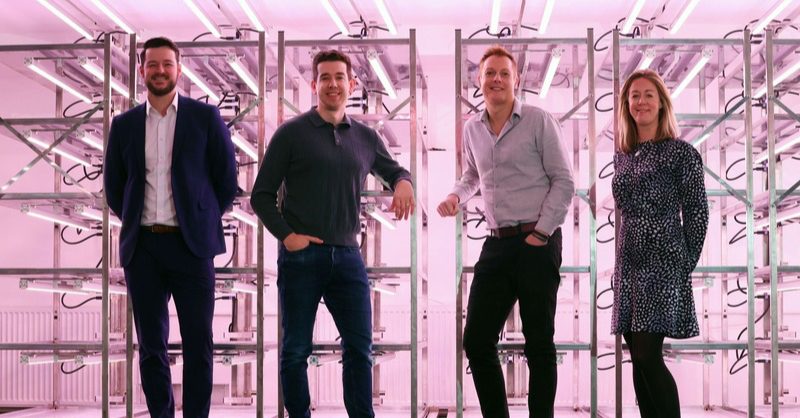
Bloemteknik raises £2.5M to rewire the future of vertical farming
UK startup Bloemteknik, founded by former GE executives, has secured a £2.5 million funding round to develop intelligent lighting systems designed to act as the “brain” of next‑generation vertical farms. The company aims to shift lighting from a passive utility to an active, data‑driven control layer that optimises plant growth, energy use and operational efficiency.
From industrial giants to climate‑smart agriculture
Bloemteknik’s founding team brings decades of experience from GE and other industrial technology leaders, where they worked on complex automation, sensor networks and large‑scale energy systems. That background now underpins a new approach to controlled‑environment agriculture.
Instead of treating lights as simple fixtures that switch on and off, Bloemteknik is building networked, software‑defined luminaires that continuously sense and respond to what is happening in a farm. By fusing lighting control with real‑time data analytics, the company wants its platform to function as the primary decision engine inside vertical farms.
Smart lights as the operating system of indoor farms
The core of Bloemteknik’s proposition is that lighting infrastructure is already everywhere inside indoor farms, making it an ideal backbone for an integrated control system. The new funding will accelerate development of a platform where the lights do far more than emit photons.
Embedded sensors and real‑time crop intelligence
Each Bloemteknik fixture is designed to work as a distributed node in a wider network. Integrated sensors can capture data on temperature, humidity, light intensity, and in some configurations, even spectral reflection from leaves that indicates plant health or stress. This information is fed into AI algorithms that learn how different crops respond to particular lighting patterns and environmental conditions.
By turning the lighting grid into a dense sensing mesh, Bloemteknik aims to give farmers continuous visibility into crop performance at a highly granular level, rack by rack and tray by tray.
Dynamic light recipes for yield and quality
Beyond monitoring, the system actively adjusts light output to optimise growth. Using programmable LED spectra and intensity control, the platform can run complex “light recipes” tailored to each crop and growth stage. For example, leafy greens might receive higher blue content during early growth to encourage compact morphology, while fruiting crops could be exposed to nuanced red‑far red balances to influence flowering and yield.
These recipes are not static. The company’s machine learning models can adapt them automatically based on observed outcomes, continually refining settings to improve yield, nutritional quality and energy efficiency.
Tackling energy costs, the Achilles’ heel of vertical farming
One of the most pressing challenges for vertical farms is the high cost of electricity, with lighting often accounting for the largest share of the energy bill. Bloemteknik’s technology directly targets this pain point.
By coordinating light intensity with real‑time plant needs and external factors such as dynamic energy pricing, the system can dim or reschedule non‑critical lighting without compromising crop outcomes. Over time, this type of intelligent load management can significantly reduce operating costs and improve the economics of indoor farming projects.
For investors and operators, the promise is a platform that not only grows better plants but also makes the business model of indoor agriculture more resilient in the face of volatile energy markets.
Positioning in a crowded agritech landscape
The vertical farming sector has seen a wave of investment over the past decade, followed by a period of consolidation and scrutiny as several high‑profile ventures struggled with profitability. In this context, Bloemteknik is positioning itself not as a farm operator, but as a core agritech infrastructure provider.
Rather than building and running farms, the company intends to supply its smart lighting and control platform to existing and new vertical farm operators, greenhouse owners and potentially research institutions. This “picks and shovels” strategy allows Bloemteknik to scale across multiple customers and geographies without taking on the capital intensity of building its own facilities.
Integration with existing farm management systems
A key part of the roadmap is interoperability. Bloemteknik is developing interfaces to connect its lighting brain with third‑party farm management software, HVAC systems, irrigation controllers and climate computers. The aim is a unified control layer where lighting decisions are synchronised with temperature, CO₂ dosing and nutrient delivery.
For operators, this could reduce the current fragmentation of tools and dashboards and support more robust automation of routine tasks, from seeding and transplant scheduling to harvest planning.
How the £2.5M will be deployed
The fresh capital will be channelled into three main areas: product development, pilot deployments and commercial expansion.
- Product development: Enhancing the hardware design of the smart luminaires, expanding the software platform, and refining AI models for different crop types.
- Pilot projects: Partnering with leading vertical farms in the UK and Europe to validate performance, quantify energy savings and benchmark yield improvements.
- Go‑to‑market: Building a sales and technical support team capable of serving commercial farms, equipment integrators and potential OEM partners.
These pilots will be critical for generating independent data on the platform’s impact, a key factor for future fundraising and broader adoption.
Why smart lighting is central to the next wave of food systems
As climate volatility, water scarcity and urbanisation strain traditional agriculture, controlled‑environment systems are increasingly seen as part of the answer. However, the sector’s long‑term viability hinges on solving the intertwined challenges of energy efficiency, labour productivity and crop consistency.
By embedding intelligence into the most pervasive piece of infrastructure inside indoor farms, Bloemteknik is betting that the pathway to more sustainable food production runs through smarter photons. If its technology can materially lower energy use while boosting yields, smart lighting could become the de facto operating system for vertical farms rather than just another line item in the equipment list.
For now, the £2.5 million raise gives the ex‑GE‑led team the runway to prove that turning lights into brains is more than a metaphor – it could be a blueprint for the next generation of climate‑resilient farming.