

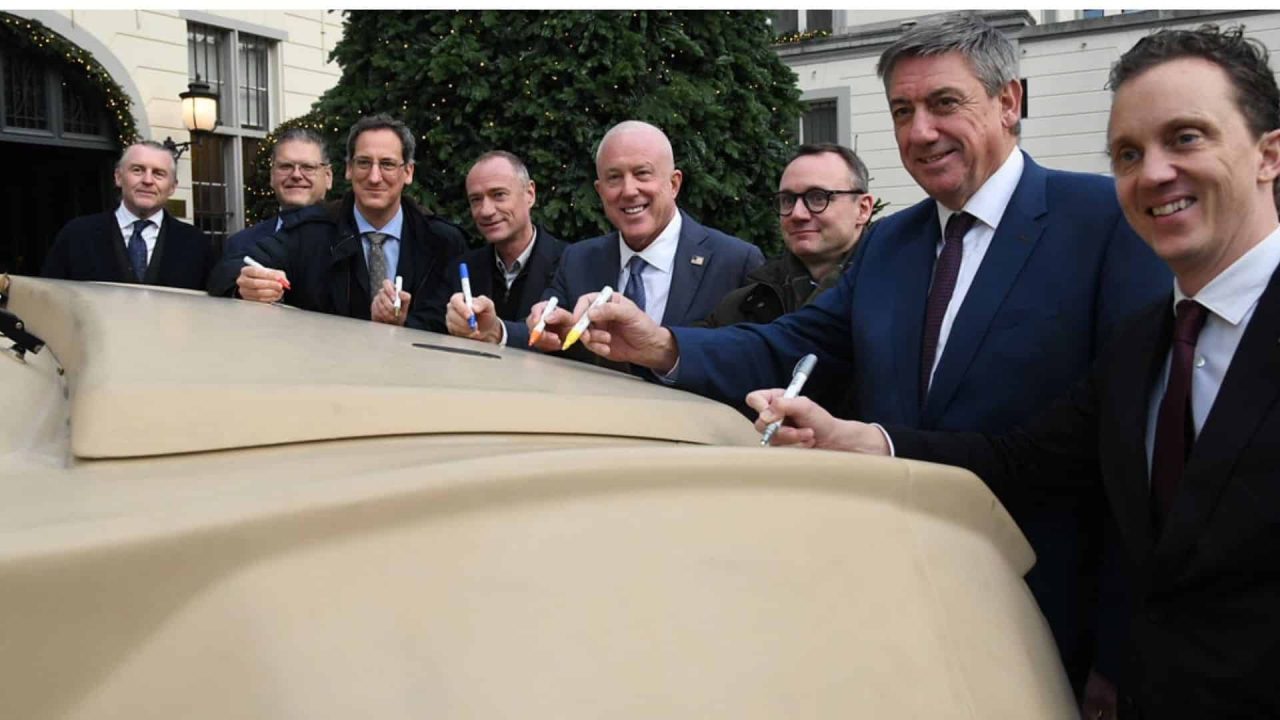
Aidoptation, a Belgian-American startup developing advanced autonomous driving systems, has secured €20 million in fresh funding to expand its technology beyond controlled racetrack environments and into real-world applications across mobility and defence. The round underscores growing investor appetite for dual-use autonomy—software and hardware stacks that can serve both commercial transportation and security-focused missions—at a time when Europe and the US are accelerating investment in resilient, high-performance robotics.
From racetrack testing to real-world autonomy
Racetracks have become a proving ground for next-generation AI algorithms in driving. They offer repeatable conditions, measurable performance targets, and the ability to push vehicles to their limits without the unpredictability of public roads. For companies like Aidoptation, the track is not an end goal; it is a controlled laboratory to validate perception, planning, and control systems under extreme speeds and edge cases.
The company’s strategy is to use performance driving scenarios to harden its autonomy stack—stress-testing how quickly a system can interpret sensor data, predict trajectories, and execute safe maneuvers. The new €20 million injection is intended to help translate those gains into deployments where the constraints are different: mixed traffic environments, changing weather, diverse road geometry, and stricter regulatory oversight.
What the €20 million will likely fund
While the funding announcement signals a clear scale-up ambition, moving from track validation to broad deployment typically requires investment across multiple fronts. For an autonomy company, that usually includes:
Productization and engineering scale
Building a reliable, repeatable product involves far more than demonstrating peak performance. It requires robust software tooling, standardized integration processes, and long-term maintainability. The company is expected to expand engineering capacity to mature its autonomy stack into a deployable platform suitable for OEMs, fleet operators, and government customers.
Data, simulation, and safety assurance
Modern autonomous driving depends on vast data pipelines and high-fidelity simulation. Scaling typically means collecting more diverse datasets, improving labeling and validation workflows, and increasing simulation coverage for rare but critical scenarios. Safety assurance—documenting how the system behaves, fails safely, and can be audited—becomes central when entering public-road mobility or defence procurement pathways.
Hardware integration and sensor strategy
Even software-centric autonomy providers must prove integration with real vehicles and sensor suites, whether camera-first, lidar-heavy, radar-augmented, or multi-modal. Funding often supports reference vehicle builds, testing fleets, and partnerships to ensure the stack performs consistently across platforms.
Why mobility and defence are converging around autonomy
The funding narrative highlights two adjacent markets—mobility and defence—that increasingly share the same enabling technologies. In mobility, autonomy promises safer operations, higher utilization, and reduced operational costs for logistics and transport. In defence, autonomy can support reconnaissance, supply missions, and remote operations that reduce risk to personnel.
What makes the overlap commercially attractive is that both markets require similar core capabilities: robust perception in degraded conditions, reliable decision-making under uncertainty, and resilient control systems. A company that can demonstrate performance at the limits—such as high-speed track scenarios—can present a compelling case that its stack is engineered for demanding environments.
Competitive landscape: a crowded field with clear differentiators
Autonomy remains one of the most competitive arenas in technology. Many players have strong demos, but fewer have scalable products that can be deployed and maintained at fleet level. Differentiation often comes down to measurable safety performance, cost-efficient compute requirements, sensor flexibility, and the ability to operate across geographies with different rules and infrastructure.
For Aidoptation, positioning the racetrack as a validation tool can be a strategic advantage if it translates into quantifiable metrics—latency improvements, higher stability at the edge of traction, or better recovery behaviors during near-loss-of-control scenarios. Investors frequently look for evidence that such performance correlates with safer outcomes in everyday settings, not just faster lap times.
What this means for Europe’s autonomy ecosystem
European startups working on autonomous driving face a complex environment: fragmented regulations, diverse road networks, and strong incumbents in automotive manufacturing. At the same time, Europe has increased attention on strategic technologies, including robotics and defence-adjacent innovation. A €20 million raise signals that well-positioned teams can still attract meaningful capital—especially when they can articulate a path to revenue in multiple sectors.
For the broader ecosystem, deals like this can also stimulate supplier networks—testing facilities, simulation providers, sensor manufacturers, and safety certification specialists—creating a more mature pipeline for autonomy commercialization.
Key milestones to watch next
Following a scale-up round, the market will watch for concrete signals that Aidoptation is moving from R&D to repeatable deployments. Among the most important indicators are:
- Commercial pilots with mobility operators or industrial fleets, demonstrating reliability and measurable safety outcomes.
- Defence partnerships or procurement-aligned trials, which often require rigorous validation and compliance frameworks.
- Geographic expansion of testing and operations to validate performance across varied infrastructure and conditions.
- Hiring growth in safety engineering, systems engineering, and field operations—roles that typically follow early technical success.
With €20 million in new capital, Aidoptation is signaling a transition from high-performance validation to broader operational relevance. If the company can convert racetrack-hardened autonomy into dependable, auditable systems for mobility and defence, it may carve out a durable position in a market where credibility is earned through deployment—not just demonstration.
Dailyza will continue tracking how the company turns its performance-testing approach into real-world autonomy at scale, and whether dual-use demand becomes a defining growth lever for Europe’s next wave of robotics and driving intelligence.