

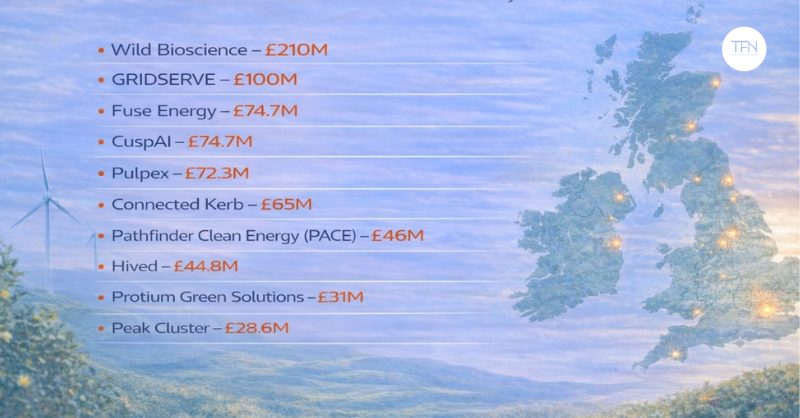
Dailyza analysis shows the UK’s climate tech sector cleared £400 million in funding during 2025, with capital concentrating in two areas investors increasingly view as “near-term scalable”: EV infrastructure and AI-driven materials. The milestone underscores how venture money is shifting from broad sustainability narratives toward technologies that can be deployed quickly, reduce costs, and unlock measurable emissions cuts.
The funding figure, reported by industry tracking and startup coverage in late December, reflects a year in which founders faced a tougher macro backdrop but benefited from renewed urgency around energy security, grid modernisation, and industrial decarbonisation. While the UK remains smaller than the US in absolute venture volumes, it continues to punch above its weight in early-stage innovation—particularly where software meets hard infrastructure.
Where the money went: EV charging and the grid edge
A significant share of 2025’s UK venture capital into climate tech flowed into companies building and operating EV charging networks, charging management software, and grid-integrated solutions. Investors are treating charging as a critical bottleneck for adoption: without reliable, affordable access—especially in dense urban areas and for drivers without off-street parking—EV sales targets become harder to achieve.
Why EV infrastructure is attracting investors now
Several forces converged in 2025 to make EV infrastructure a standout category. First, utilisation rates are rising in many regions as fleets electrify and consumer adoption continues. Second, the business models are maturing: operators are moving beyond “build-first” expansion to focus on uptime, pricing strategy, and partnerships with fleets, retailers, and property owners.
At the same time, the grid is becoming an active participant in charging economics. Software that can shift charging loads to off-peak periods, respond to price signals, or coordinate distributed assets is increasingly central. This “grid edge” layer—where vehicles, chargers, and buildings interact—has become a core thesis for many climate-focused funds.
AI materials: decarbonising industry through smarter discovery
The second major magnet for capital in 2025 was AI materials—startups applying AI algorithms and advanced simulation to discover, optimise, and scale new materials. While the term can sound abstract, the industrial implications are immediate: better batteries, more efficient catalysts, lower-carbon cement alternatives, and coatings that reduce energy use across manufacturing.
From lab timelines to venture timelines
Materials science has traditionally been slow and capital intensive, with long development cycles that did not always fit venture expectations. In 2025, investors showed growing confidence that machine learning and high-throughput experimentation can compress research timelines and improve success rates. The result is a clearer path from computational discovery to pilot-scale validation—and, eventually, to commercial supply agreements.
This shift matters because heavy industry remains one of the hardest parts of the economy to decarbonise. If AI-enabled materials startups can reduce the cost of low-carbon inputs or improve performance enough to justify switching, they can influence emissions far beyond the tech sector itself.
What the £400M+ signal means for UK climate tech
Crossing the £400 million mark is less about a single headline number and more about what it reveals: the UK climate ecosystem is increasingly defined by “deployment-ready” innovation. In 2025, investors appeared to favour companies that can demonstrate near-term revenue, infrastructure partnerships, and credible routes to scale—rather than relying solely on long-range climate impact narratives.
That said, climate tech remains a broad umbrella. Funding in adjacent areas—such as energy management, industrial efficiency, and next-generation hardware—continued to form part of the overall picture, even if EV charging and AI materials drew disproportionate attention. The pattern suggests that investors are balancing two priorities: solutions that can scale quickly today, and foundational technologies that could reshape industrial systems over the next decade.
Headwinds: capital intensity and the path to scale
Despite the momentum, UK climate tech founders still face familiar constraints. Infrastructure-heavy businesses require patient capital, and the economics of charging networks, grid services, and manufacturing scale-ups can shift with electricity pricing, permitting timelines, and supply chain volatility.
For AI materials companies, the challenge is often “the last mile” from promising lab results to industrial procurement. Winning enterprise adoption typically requires rigorous testing, certification, and long sales cycles—meaning startups must pair scientific progress with commercial discipline.
Why policy and partnerships matter
In both leading categories, policy stability and public-private coordination can determine whether venture-backed innovation becomes real-world infrastructure. Grid connection queues, planning approvals, and standards for interoperability can accelerate or slow deployment. Likewise, partnerships—utilities, charge point operators, automakers, and industrial manufacturers—are increasingly decisive for go-to-market success.
2026 outlook: more focus on measurable outcomes
Looking ahead, the UK’s climate tech investment narrative is likely to hinge on demonstrable outcomes: charger uptime and utilisation, grid services revenue, cost-per-kilowatt-hour improvements, and validated performance gains from new materials. Investors will also watch whether companies can expand beyond pilot projects into repeatable rollouts—turning innovation into infrastructure.
If 2025 established EV infrastructure and AI-driven materials as the year’s defining themes, 2026 may be the year when the market demands proof at scale. For UK founders, the opportunity is substantial: build technologies that not only promise decarbonisation, but deliver it in ways customers can measure—and pay for.