

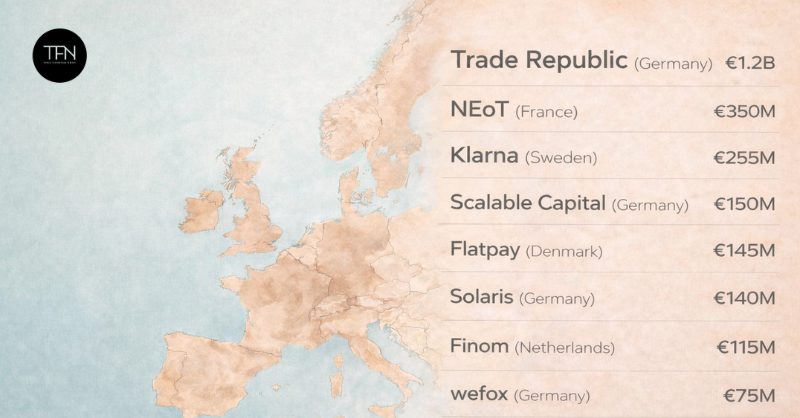
Dailyza reviewed a new roundup from TFN highlighting that Europe’s largest fintech “megadeals” in 2025 collectively exceeded €2.8B in disclosed funding. The list, published on December 26, underscores how capital is concentrating into fewer, bigger bets—particularly in companies positioned as infrastructure for modern finance rather than single-feature consumer apps.
While the roundup emphasizes “top 10+” deals, the more important takeaway is what these oversized rounds reveal about investor priorities: durable revenue, regulatory readiness, and platforms that can scale across markets. In a year when venture funding remained selective, fintech still produced late-stage rounds large enough to move Europe’s overall totals.
Why 2025’s fintech megadeals matter
Megadeals are not just big numbers; they often set the tone for how the market prices risk. When investors commit nine-figure checks, they typically do so with expectations around predictable unit economics, credible governance, and a path to liquidity—whether through an IPO window reopening or strategic acquisitions.
Europe’s fintech scene has matured into a multi-hub ecosystem—London, Paris, Berlin, Amsterdam, Stockholm, and emerging centers in Southern and Eastern Europe—yet the largest rounds tend to cluster around companies that can expand beyond one national regulatory regime. That cross-border ambition can be expensive, requiring capital for licensing, compliance, hiring, and product localization.
What investors are buying: infrastructure over hype
The renewed interest in large European fintech rounds reflects a shift away from growth-at-all-costs and toward businesses that look more like core financial infrastructure. In practice, that means payments rails, risk and underwriting tooling, treasury and liquidity management, and enterprise platforms that sell into banks and large merchants.
AI is back—this time with governance
One clear driver behind late-stage appetite is the integration of AI algorithms into credit decisioning, fraud detection, customer support, and operational automation. However, investors are increasingly focused on whether these systems can be audited and explained—especially in regulated contexts like lending and identity verification.
In Europe, the compliance angle matters more than marketing. Fintechs raising the largest rounds are expected to demonstrate strong controls around model risk, data provenance, and bias testing—requirements that can influence both product architecture and go-to-market timelines.
Revenue quality and risk discipline
After several years of repricing across tech, the biggest rounds typically go to companies with clearer revenue visibility: subscription or usage-based enterprise contracts, or transaction-driven models with high retention. Investors also care about risk discipline—particularly in lending-focused fintech—because portfolio performance can deteriorate quickly in a downturn.
That’s why 2025’s megadeals, as highlighted by TFN, are best read as a signal that some fintechs have crossed the threshold from “startup” to “systemically relevant vendor,” at least within their niches.
Why Europe can still produce large rounds in a selective market
Even when venture capital tightens, Europe has structural factors that can support large fintech financings:
- Regulatory complexity that creates defensible moats for companies able to navigate licensing and compliance across jurisdictions.
- Strong banking and payments talent pools, often drawn from incumbents and prior fintech exits.
- A growing base of later-stage funds and crossover investors willing to lead or anchor bigger rounds when metrics justify it.
At the same time, the “megadeal” phenomenon can mask a broader reality: early-stage funding may remain constrained, and mid-tier startups may struggle to raise without a sharp narrative and measurable traction. The market is rewarding outliers, not averages.
What these megadeals imply for valuations and exits
Large rounds can be a confidence signal, but they also raise the bar for outcomes. Bigger checks often come with higher expectations for valuation growth, and that can compress optionality if the IPO market stays cautious. For founders, the trade-off is clear: more capital to consolidate a category, but increased pressure to deliver scale and profitability on a tighter timeline.
From an ecosystem standpoint, the presence of €2.8B+ in megadeals suggests late-stage investors still believe European fintech can generate global leaders—particularly in B2B and infrastructure-heavy segments. But it also suggests that the path to liquidity is being priced more conservatively, with stronger emphasis on cash flow resilience and governance.
What to watch next in European fintech funding
If 2025’s top European fintech rounds are a guide, several themes are likely to shape 2026 fundraising conversations:
- More scrutiny on unit economics and payback periods, even for high-growth companies.
- Greater demand for compliance-by-design product strategies, especially where AI touches decisioning.
- Continued consolidation, as well-funded platforms acquire smaller specialists to expand product breadth.
- Selective reopening of public market narratives for the most mature fintechs, depending on macro stability.
TFN’s tally of €2.8B+ across Europe’s top 10+ fintech megadeals doesn’t just capture who raised the most—it captures where conviction remains. In a cautious market, the biggest checks are going to fintechs that look less like experiments and more like the plumbing of modern finance.