

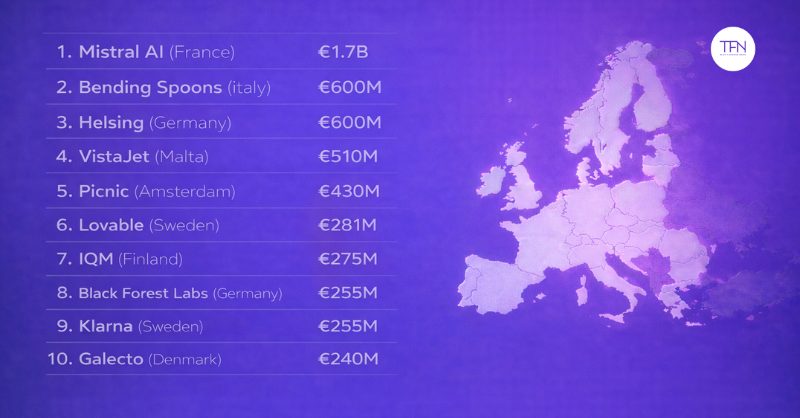
Europe is heading into its biggest startup funding year on record in 2025, powered by a return of mega-rounds and a sharp investor pivot toward strategic technologies. Two names stand out: Helsing, the defense AI company, and Mistral, the French generative AI contender, both associated with billion-dollar-scale financings that are helping reset the region’s venture narrative after a cautious stretch of fundraising.
The surge marks a notable shift from the tighter capital environment of recent years, when higher rates and weaker exits pushed many funds to slow deployment. In 2025, the pattern looks different: fewer “spray-and-pray” bets, more conviction capital, and a growing emphasis on national resilience themes such as security, sovereignty, compute, and critical infrastructure.
Why 2025 is breaking records
Europe’s funding momentum in 2025 reflects more than a single hot sector. Several forces are converging:
- Capital concentration: Investors are increasingly backing perceived category leaders, resulting in larger checks for fewer companies.
- Strategic urgency: Defense, cybersecurity, and energy resilience are now treated as long-term priorities, not niche verticals.
- AI commercialization: Buyers across industries are moving from pilots to procurement, supporting stronger revenue narratives for AI-native startups.
- Policy tailwinds: European governments and institutions are expanding support for innovation tied to security, digital sovereignty, and industrial competitiveness.
Together, these dynamics are lifting overall totals even if early-stage funding remains selective. The headline for 2025 is not simply “more money,” but “bigger rounds for fewer, strategically aligned winners.”
Helsing’s rise: defense tech becomes mainstream venture
Helsing has become a bellwether for Europe’s re-rating of defense technology. Once a sector that many venture investors avoided on reputational or mandate grounds, defense is now increasingly framed as a stability and deterrence imperative—especially as European states reassess procurement, readiness, and domestic capability.
Helsing’s ability to attract capital at scale underscores how quickly the market has shifted. Investors are looking for companies that can combine advanced software with deployable products, navigate complex government customers, and expand across allied markets. The emergence of billion-dollar rounds in this space also signals a belief that defense tech can produce venture-style outcomes—through large contracts, long-duration demand, and the potential to become foundational suppliers.
What investors are betting on
In practical terms, the Helsing story is about more than national security headlines. It is about defensible differentiation in AI algorithms, integration into real-world systems, and the ability to scale within regulated environments. For venture firms, that translates into a clearer path to durable revenues and high switching costs—attributes that became more prized as the market moved away from growth-at-all-costs.
Mistral’s momentum: Europe’s AI sovereignty play
Mistral represents another pillar of Europe’s 2025 funding surge: the race to build competitive generative AI platforms with European roots. With governments and enterprises increasingly sensitive to data governance, model control, and supply-chain risk, “AI sovereignty” has evolved from policy language into an enterprise buying criterion.
Mistral’s ability to draw large-scale investment reflects confidence that Europe can produce globally relevant AI companies—not only application-layer startups, but also model builders and infrastructure-adjacent players. Investors are watching for proof that European AI champions can win enterprise contracts, build robust partnerships, and compete on performance while meeting regional compliance expectations.
From research to revenue
The new test for generative AI companies is commercialization. Buyers want secure deployments, predictable costs, and integration with existing workflows. That demand is pulling funding toward teams that can ship products, support enterprise-grade needs, and build ecosystems around their models. In 2025, the market is rewarding firms that can show traction and credible routes to sustainable unit economics rather than relying solely on hype cycles.
What this means for Europe’s venture market
Europe’s record-setting year is reshaping how global capital views the region. For years, a common critique was that Europe produced strong technical talent but struggled to finance companies through late-stage growth, often forcing founders to look to the U.S. for larger rounds. The appearance of more billion-dollar financings suggests that the late-stage gap is narrowing—at least for top-tier companies operating in priority sectors.
At the same time, the rebound is uneven. Many early-stage startups still face tougher diligence, slower timelines, and greater pressure to demonstrate product-market fit quickly. The market’s center of gravity is moving toward fundamentals: revenue quality, capital efficiency, and credible differentiation.
Sector signals: where the money is going
While defense tech and generative AI are capturing the headlines, the broader pattern points to a shortlist of themes that investors see as structurally important:
- Cybersecurity and identity
- Climate and energy systems, especially grid, storage, and industrial efficiency
- Semiconductors and compute infrastructure
- Industrial automation and robotics
- Fintech infrastructure with clear compliance and profitability paths
The bigger question: can exits keep up?
Record funding totals ultimately raise a practical question for founders and limited partners: will Europe deliver enough high-quality exits to justify the renewed pace of investment? Public markets and M&A activity have improved in pockets, but the region’s exit environment remains a key variable for how long the mega-round cycle can last.
For now, the signals from 2025 suggest investors are willing to underwrite longer timelines for companies aligned with strategic demand—especially where governments, defense budgets, or enterprise procurement provide durable tailwinds. If Helsing and Mistral translate their fundraising momentum into scaled revenues and global market presence, they could help define a new benchmark for what European startups can become in the late stage.
Dailyza will continue tracking Europe’s biggest rounds, the sectors drawing the deepest pools of capital, and whether 2025’s record pace marks a sustained reset or a peak driven by a handful of outsized deals.