

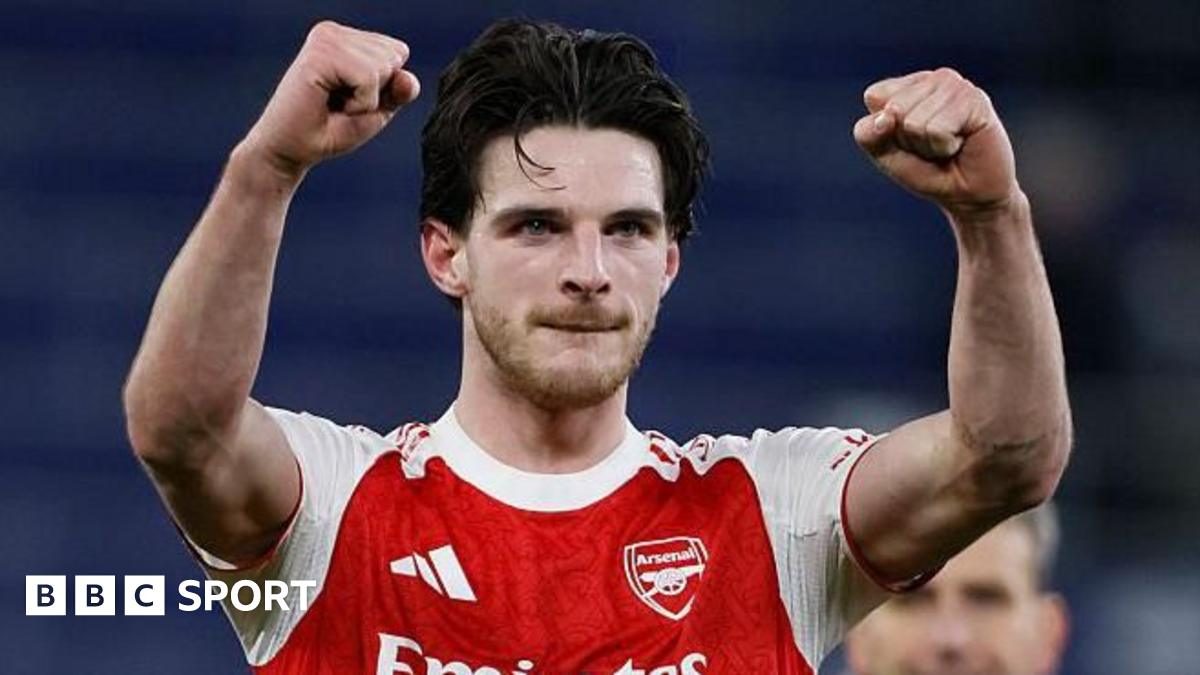
Wayne Rooney has tipped Arsenal midfielder Declan Rice to become the next long-term leader of England, calling the 26-year-old an “incredible” player and a natural successor to current skipper Harry Kane.
Speaking on BBC Sport’s programme, Rooney—who captained England between 2014 and 2017—delivered his verdict after watching Arsenal grind out a 1-0 victory away to Everton, a result that lifted Mikel Arteta’s side back to the top of the Premier League.
Rooney’s verdict: Rice is “waiting” to take over from Kane
Rooney’s central argument is simple: Rice already plays with the authority and responsibility of a captain, and he appears poised to inherit the armband when Kane eventually steps away from international duty.
“For me, he’s the one who’s probably waiting for Harry to hang up his boots at some point,” Rooney said, pointing to Rice’s influence across multiple phases of play—defending, building, and arriving in attacking areas at the other end.
Rice has already worn the armband twice at senior level in Kane’s absence, including a 2-2 draw with Belgium in March 2024 and a 3-0 win over Wales in October. Those came in high-profile fixtures where leadership, composure and tactical discipline are heavily scrutinised, particularly in midfield.
What Rooney saw at Everton: control, detail and tactical intelligence
Rooney’s praise focused on Rice’s “decision-making” and the “detail” in his passing—qualities that often separate elite midfielders from merely good ones. In Rooney’s description, Rice did not simply complete passes; he selected the right option, at the right time, with the right weight and angle.
“He was all over the pitch,” Rooney said, highlighting Rice’s ability to shift roles within the same match: receiving from the centre-backs, shielding the defence, and then progressing into the box to threaten goal.
That blend—part holding midfielder, part organiser, part late runner—has become increasingly valuable in modern football, where top teams demand midfielders who can cover ground without compromising structure. Rooney noted that some of Rice’s work can be “underrated,” particularly the off-ball positioning and the willingness to drop into deeper areas to steady the game.
Why Rice’s role matters for England
International football often turns on fine margins: a moment of transition, a lapse in concentration, or a midfield that can’t control tempo. Rooney’s assessment suggests Rice provides the kind of reliability that managers lean on in tournament football—someone who can protect a lead, slow a match down, or raise intensity when required.
Rooney also pointed to Rice’s personality and standing within squads. “Everyone seems to love him,” he said, arguing that leadership is not only about tactics but also about trust and connection inside the dressing room.
- Leadership profile: already trusted with the armband in Kane’s absence.
- Tactical versatility: can operate as a deep midfielder or drop in as an auxiliary defender.
- Consistency: influences matches even when not producing headline moments.
Rooney on Dominic Calvert-Lewin: World Cup door still open
Rooney also used the discussion to weigh in on Dominic Calvert-Lewin, arguing the forward could still enter the conversation for next summer’s World Cup—to be held in the USA, Mexico and Canada—if his current run continues.
Calvert-Lewin, 28, has found form after a slow start to his Leeds United spell. Rooney said England’s options in attack could create an opening for an in-form striker who offers physicality, aerial threat, and presence in both penalty areas.
“If he continues this, then there’s no reason why he shouldn’t be talked about—or even get an opportunity—to go to the World Cup,” Rooney said, pointing to what he described as a relative lack of forward depth.
Rooney, who previously played alongside Calvert-Lewin at Everton, also reflected on why Everton’s decision not to renew the striker’s contract made sense at the time, given recurring fitness issues. He suggested the move has benefited the player, citing improved availability and the work of Leeds’ medical staff.
Rooney’s take on Viktor Gyokeres: impact beyond goals
Another name discussed was Viktor Gyokeres, the Arsenal striker whose summer arrival from Sporting brought heavy expectations. Although he scored the winner against Everton via an emphatic penalty—his seventh goal of the season in all competitions—Rooney acknowledged that the Swede’s recent scoring run has been uneven.
Still, Rooney argued that judging a striker only by goals can miss the wider value they provide, particularly in matches where space is limited and defenders sit deep. He pointed to Gyokeres’ ability to occupy centre-backs and create room for attacking midfielders and wide players moving inside.
“He occupies the two centre-backs… That creates a bit more space for your number 10 or your wide players,” Rooney said, framing Gyokeres as a facilitator as well as a finisher.
What it means for Arsenal and England heading into a defining stretch
For Arsenal, the immediate takeaway is that Rice continues to justify his status as a central pillar in Arteta’s system—someone who can help win “scrappy” games as well as dominate more open contests. For England, Rooney’s comments add to a growing sense that the next leadership era is already taking shape.
Kane remains the captain and a key figure, but Rooney’s endorsement places Rice firmly in the conversation as the player most likely to steer the team through the next cycle—one built on midfield control, tactical flexibility, and a dressing-room presence that teammates naturally follow.