

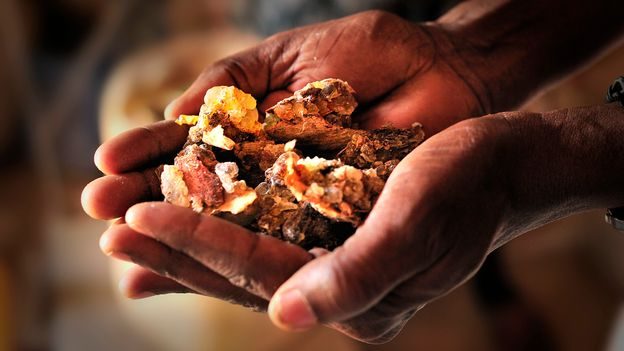
Dailyza — The sweet, woody scent of frankincense is woven into religious rituals, winter celebrations and, increasingly, the booming global wellness industry. But far from boutique essential-oil shelves and holiday diffusers, the resin’s natural source is under mounting strain. Across parts of the Horn of Africa, harvesters and researchers warn that the Boswellia trees that produce frankincense are being pushed beyond their limits by heavy tapping, weak oversight, pests and climate stress.
A livelihood carved into the highlands
In Somaliland’s Sanaag region, frankincense harvesting is not a seasonal hobby; it is a way of life. Experienced harvesters spend months in remote terrain, often camping near their groves, moving from tree to tree to check bark health, clear sand, and protect seedlings. The work is physically demanding and highly dependent on stable tree health and predictable seasons.
Frankincense comes from several species of hardy desert trees that can cling to cliffs and survive in thin soils. Harvesters make small cuts in the bark, allowing resin to seep out. Over weeks, it hardens into pale, aromatic “tears” that can be scraped off and sold. Done carefully, tapping can be sustained over time. Done aggressively, it can weaken trees, reduce seed production and leave groves vulnerable to disease.
Demand rises, and tapping intensifies
Frankincense is among the oldest globally traded commodities, historically prized from the Mediterranean to Asia. Today, it has found new life as a staple ingredient in aromatherapy, incense, cosmetics and traditional remedies. That popularity is expanding alongside the multi-trillion-dollar wellness economy, increasing pressure on supply chains that are often informal and difficult to regulate.
In many producing areas—particularly in Somaliland, Somalia, Ethiopia and Sudan—harvesters are frequently paid based on output. That structure can reward high volumes over long-term stewardship, especially when prices fluctuate and households need immediate cash. Experts also point to the influence of middlemen in fragmented supply chains, where a lack of clear standards or enforcement can encourage over-tapping and underinvestment in conservation.
What “over-tapping” does to a Boswellia tree
Like maple syrup production, frankincense relies on tapping, but the biology and recovery time are different. Excessive incisions can stress the tree, reduce its ability to heal and make it more susceptible to pests. A 2022 report cited in recent coverage found that recovery from damage linked to excessive harvesting can take a decade or more—an alarming timeline for communities that depend on annual resin income.
When trees are repeatedly cut too deeply or too frequently, they may produce less resin over time, become less fertile, or die prematurely. For harvesters, that means a shrinking resource base. For buyers and brands, it raises a difficult question: how long can rising demand be met if the source trees are not given time to regenerate?
Climate stress and pests add another layer of risk
Overharvesting is only one part of the story. Researchers and local observers say climate variability is already affecting some frankincense-producing landscapes. Hotter temperatures, shifting rainfall patterns and prolonged dry periods can reduce seedling survival and slow regeneration—particularly in areas where young trees are already struggling to establish.
Pests are also taking a toll. Outbreaks of wood-boring beetles have been reported as a serious threat in some Boswellia populations, compounding stress from human harvesting. Once weakened, trees can become easier targets for infestations, creating a feedback loop of decline.
A supply chain that rewards volume, not stewardship
Frankincense is frequently traded through layers of intermediaries before reaching exporters and global manufacturers. In regions affected by political uncertainty and limited government capacity, regulation can be inconsistent or absent. That can leave harvesters exposed to volatile pricing and limited bargaining power, while also making it difficult to enforce sustainable practices across a dispersed landscape.
The result is a market dynamic where the people doing the most difficult work—tapping trees in remote highlands—may receive meagre returns, while the incentives to protect long-term tree health remain weak. Sustainability efforts, where they exist, often face practical hurdles: monitoring remote groves, training harvesters, standardising tapping techniques, and ensuring that higher prices for responsibly sourced resin actually reach producers.
What sustainable frankincense could look like
Specialists and conservation-minded traders increasingly argue that frankincense must be treated as a forest product that requires active management, not an endlessly extractable commodity. That could include:
- Setting limits on the number and depth of cuts per tree during a season to reduce stress and improve recovery.
- Rotating harvest schedules so trees receive rest periods, allowing bark and resin systems to heal.
- Protecting seedlings and encouraging natural regeneration, including fencing or community rules to reduce damage.
- Improving traceability so buyers can verify origin and harvesting practices, and reward sustainable producers.
- Developing fairer purchasing agreements that reduce pressure on harvesters to maximise short-term output.
These steps require coordination across communities, traders and end-market companies—along with credible verification. Without it, “sustainably sourced” risks becoming a label without measurable impact.
Why it matters beyond incense and essential oils
The frankincense story sits at the intersection of biodiversity, rural livelihoods and global consumer trends. When a product tied to tradition and spirituality becomes a mass-market wellness staple, the strain often shows up first in remote landscapes and low-income communities.
For harvesters in Somaliland and neighbouring regions, the health of Boswellia groves is not abstract environmentalism; it is household income, food security and continuity of a craft passed down through generations. For global buyers, it is a test of whether demand can be met without hollowing out the ecosystems and communities that make the product possible.
As the scent of frankincense continues to drift through churches, homes and spas worldwide, the future of the resin may depend on whether the trees that produce it are given time—and economic reason—to survive.