

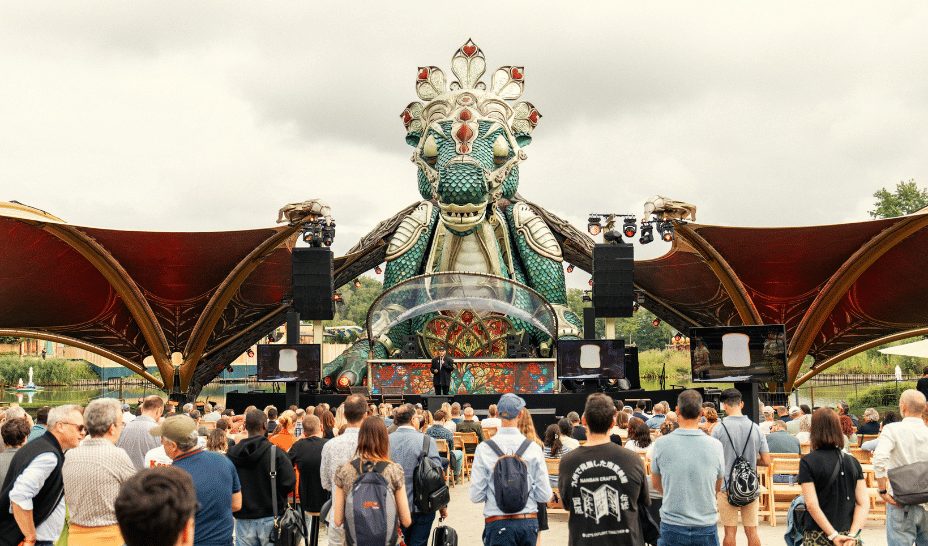
Dailyza looks at a growing playbook in European innovation: borrowing the energy and community mechanics of major cultural events to accelerate corporate–startup collaboration. In an interview published by EU-Startups, Mats Raes—a driving force behind Love Tomorrow and Impact Circle—outlined how the spirit associated with Tomorrowland can be translated into practical frameworks that help big companies and startups build partnerships that actually ship.
From festival culture to business outcomes
The premise is simple but ambitious: when people feel part of a mission-driven community, they share information faster, take meetings more openly, and show up ready to collaborate. Raes argues that what makes Tomorrowland iconic isn’t only production value—it’s the intentional design of belonging. In the corporate world, that design can become a catalyst for open innovation, where enterprises source solutions externally rather than relying solely on internal R&D.
In practice, Love Tomorrow positions itself at the intersection of culture, sustainability, and business. The platform’s goal is to convene decision-makers, founders, and experts around shared priorities—particularly climate and social impact—then convert that momentum into pilots, procurement discussions, and longer-term partnerships.
What Impact Circle is trying to fix in corporate innovation
Corporate–startup collaboration often fails for predictable reasons: mismatched timelines, unclear ownership, procurement bottlenecks, and pilots that never scale. Impact Circle, as described by Raes, is built to reduce these friction points by creating a structured environment where both sides can align on expectations early—what success looks like, what budget or resources are available, and who has the authority to move a project forward.
Rather than treating collaboration as a series of one-off introductions, the model emphasizes continuity: repeated touchpoints, curated matching, and community accountability. The idea is that a trusted network can shorten the distance between a promising demo and a signed commercial agreement—especially when sustainability targets are on the line and organizations are under pressure to show results.
Why the “Tomorrowland spirit” resonates with corporates
Large organizations increasingly face a dual mandate: keep core operations stable while adapting to fast-moving shifts in regulation, customer expectations, and technology. That tension is especially visible in sustainability, where companies must balance near-term costs with long-term resilience. Raes frames the “Tomorrowland spirit” as a way to unlock the human side of transformation—optimism, creativity, and willingness to collaborate—without losing focus on deliverables.
For corporates, the attraction is not a festival aesthetic; it’s a different operating rhythm. Startups often move quickly by default, while enterprises move carefully by necessity. A well-designed innovation community can create a neutral space where both can meet: corporates gain access to tested solutions and entrepreneurial speed; startups gain access to distribution, domain expertise, and budgets.
How partnerships move from inspiration to implementation
One of the most valuable signals in the interview is the emphasis on execution. Many innovation initiatives generate enthusiasm but struggle with follow-through. Impact Circle aims to push beyond inspiration by making collaboration measurable—tracking whether introductions lead to workshops, whether workshops lead to pilots, and whether pilots lead to contracts.
That focus reflects a broader shift in Europe’s innovation ecosystem: as capital becomes more selective and enterprises demand clearer ROI, the bar for partnership programs rises. It’s no longer enough to host a networking event or publish a glossy sustainability report. Companies want solutions that reduce emissions, improve efficiency, or strengthen compliance—while startups need predictable paths to revenue.
What corporates typically need to make deals happen
- Clear sponsorship from an executive who can remove blockers and approve next steps
- Defined problem statements so startups aren’t pitching blindly
- Procurement alignment early, so pilots aren’t derailed by contracting requirements
- Data access and internal champions to support integration and testing
What startups need from the corporate side
- Realistic timelines and a single point of contact who owns the relationship
- Budget clarity—even for pilots—so the engagement is not purely exploratory
- Path to scale, including criteria for expanding beyond a proof-of-concept
The sustainability angle: impact with accountability
Love Tomorrow and Impact Circle sit in a crowded field of sustainability initiatives, but the interview underscores an important distinction: the goal is to convert sustainability ambition into operational change. That matters because the sustainability space is often criticized for vague commitments. A partnership model that connects corporates with startups offering measurable improvements—whether in energy management, circular materials, mobility, or reporting—can help shift the conversation from pledges to performance.
For European companies navigating evolving disclosure standards and stakeholder scrutiny, structured collaboration can also reduce risk. Working with vetted startups inside a curated ecosystem may provide more confidence than ad-hoc sourcing, particularly when solutions touch core infrastructure or sensitive data.
What this signals for Europe’s corporate–startup ecosystem
The interview reflects a broader trend: innovation is becoming more community-driven and more outcome-oriented at the same time. The “community” part is not soft—it is increasingly seen as infrastructure, a way to build trust and speed up decisions. The “outcome” part is equally critical: with tighter budgets and higher expectations, programs must show tangible progress in startup partnerships, procurement, and impact metrics.
As Raes suggests, the most effective collaborations are built when people are energized by a shared mission and supported by a structure that makes action easy. For corporates and startups trying to work together in 2025’s more demanding environment, that combination—culture plus execution—may be the difference between another round of introductions and a partnership that lasts.