

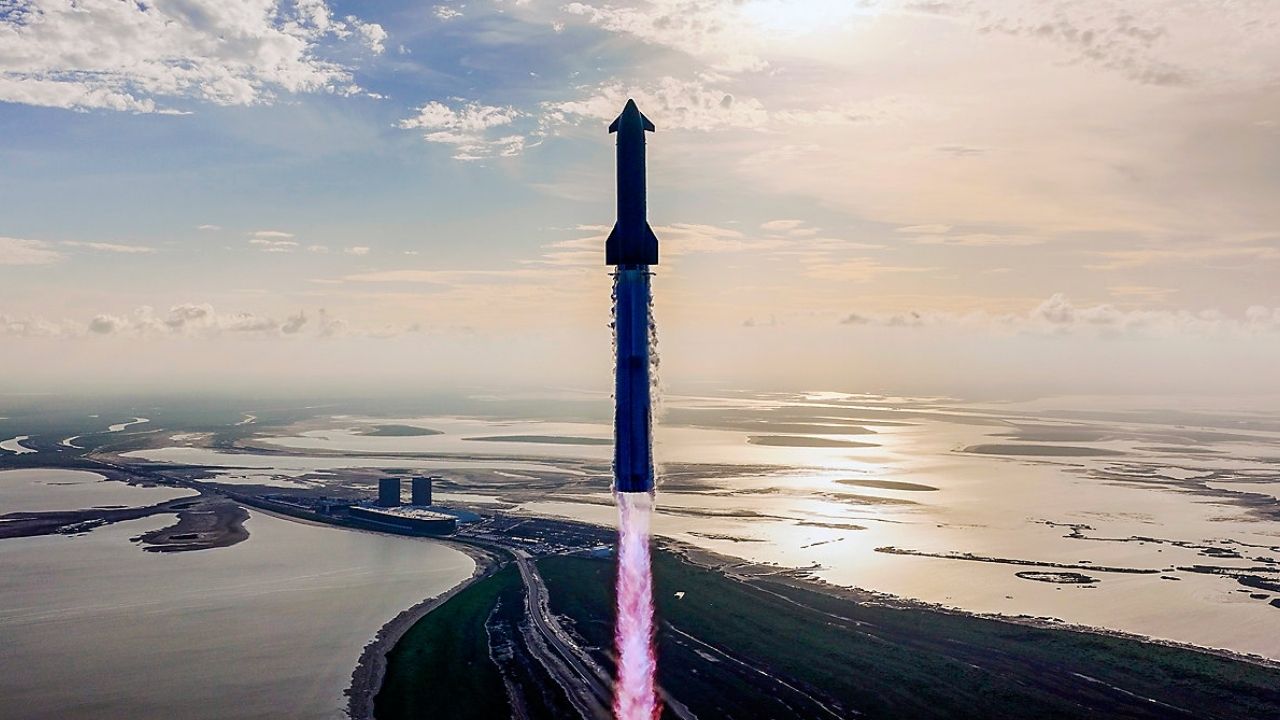
SpaceX achieves a historic milestone as the fully reusable Starship executes its first commercial mission, revolutionizing orbital economics.
The global aerospace industry witnessed a paradigm shift this morning as SpaceX successfully completed the first fully commercial flight of its colossal Starship launch vehicle. Lifting off from the Starbase facility in Boca Chica, Texas, the mega-rocket deployed a record-breaking payload of 400 next-generation Starlink V3 satellites into low-Earth orbit before executing a precision landing of both the Super Heavy booster and the Ship.
Redefining Access to Space
Industry analysts emphasize that this mission marks the official end of the “expendable” era. With a payload capacity exceeding 150 metric tons and a targeted launch cost of under $10 million per flight, Starship has effectively lowered the price of putting mass into orbit by an order of magnitude. Elon Musk, observing from the control center, stated that this capability is critical for the upcoming Mars transfer windows scheduled for late 2026.
The Payload: Starlink V3
The mission’s primary objective was the deployment of the heavy Starlink V3 satellites, which are too massive for the legacy Falcon 9 fleet. These new units feature direct-to-cell capabilities, allowing standard smartphones to connect directly to the satellite network without specialized hardware. Telecom partners like T-Mobile and Rogers have confirmed that beta testing for global SMS and voice coverage will commence next month, leveraging this new orbital infrastructure.
Competitors Struggle to Respond
The success of Starship places immense pressure on rival launch providers. Blue Origin‘s New Glenn, which saw its maiden flight earlier this year, and ULA‘s Vulcan rocket now face a competitor that offers significantly higher mass-to-orbit at a fraction of the price. Market reports suggest that several commercial satellite operators are already renegotiating launch contracts to switch to the Starship manifest for 2026 and 2027.
1 Comment
This launch really feels like a game-changer for space travel and satellite deployment. The fact that both the booster and the ship landed safely shows how far reusable tech has come. Excited to see what this means for the future of affordable access to orbit!